Here's what we've observed: every time your system kicks into auxiliary heat mode, it runs longer and harder — dislodging settled dust, dander, and debris from your ductwork and pushing it straight into your living spaces. It's one of the most overlooked air quality triggers we encounter, and it hits hardest during the cold-weather stretches when auxiliary heat runs most.
This page breaks down exactly what's happening to your air, the signs to watch with confidence, and the steps you can take to keep your family comfortable and protected when temperatures fall — with a clear, reassuring explanation of what does auxiliary heat mean.
TL;DR Quick Answers
What Does Auxiliary Heat Mean?
Auxiliary heat — shown as "Aux Heat" on your thermostat — is your heat pump's automatic backup heating system. It activates when outdoor temperatures drop too low for your heat pump to reach your set temperature on its own.
Key facts about auxiliary heat:
It is a normal, built-in feature of heat pump systems
It activates automatically — no manual input required
It typically triggers when outdoor temperatures fall below 30°F to 35°F
It runs alongside your heat pump — not instead of it
Short bursts during cold weather are expected and normal
Constant operation signals a system issue that needs attention
What auxiliary heat is not:
It is not a malfunction
It is not the same as emergency heat
It is not a reason to call a technician — unless it runs constantly
What most homeowners miss: auxiliary heat doesn't just affect your energy bill. It runs hotter and longer than normal operation, dislodging dust, pet dander, and mold spores from ductwork and pushing them into your living spaces. Checking and upgrading your air filter before the heating season is the single most effective step you can take to protect your home's air quality when auxiliary heat runs most frequently, and it can also support smarter, more confident HVAC replacement planning when the time is right.
Top Takeaways
Auxiliary heat directly affects indoor air quality — not just your energy bill. Longer run cycles dislodge settled dust, dander, and mold spores from ductwork and push them into your living spaces.
Filters load faster during auxiliary heat operation. What normally takes 30 days can happen in under two weeks during a hard cold stretch — often with no visible warning signs.
High-risk households need to act before the heating season. Pets, allergy sufferers, asthma patients, and young children are most vulnerable when aux heat runs frequently. A MERV 11 or MERV 13 filter is the most direct line of defense.
Fixed calendar schedules don't work during the heating season. Check your filter based on how hard your system is working — not what the calendar says.
Three steps to take before temperatures drop:
Check your current filter condition
Upgrade your MERV rating if your household is high-risk
Plan to inspect more frequently during any cold stretch with extended aux heat operation
What Auxiliary Heat Actually Is — and Why It Matters for Your Air
Most homeowners know auxiliary heat as the backup setting that kicks in when temperatures drop and their heat pump can't keep up on its own. What they don't know is what that mode does to the air inside their home.
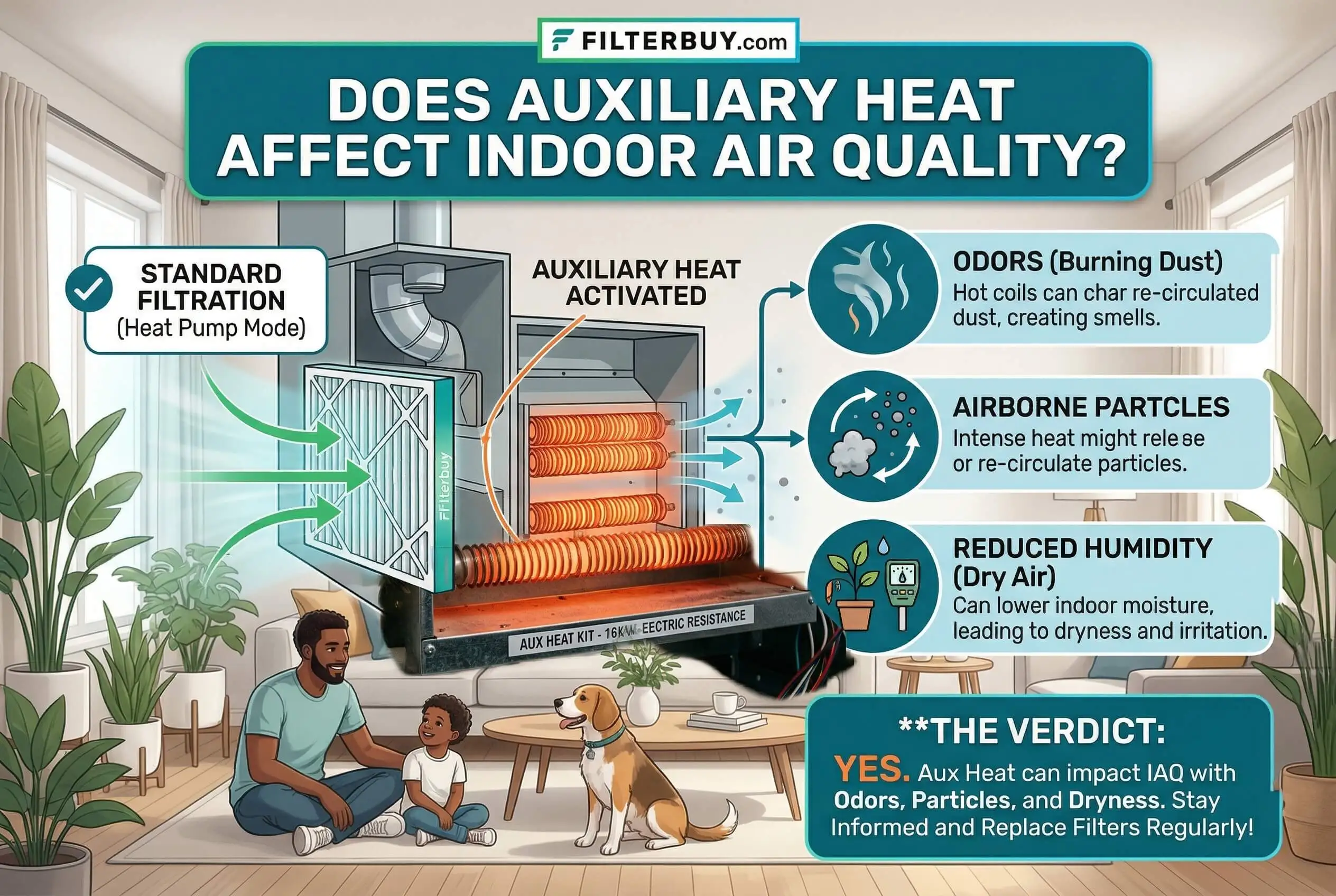
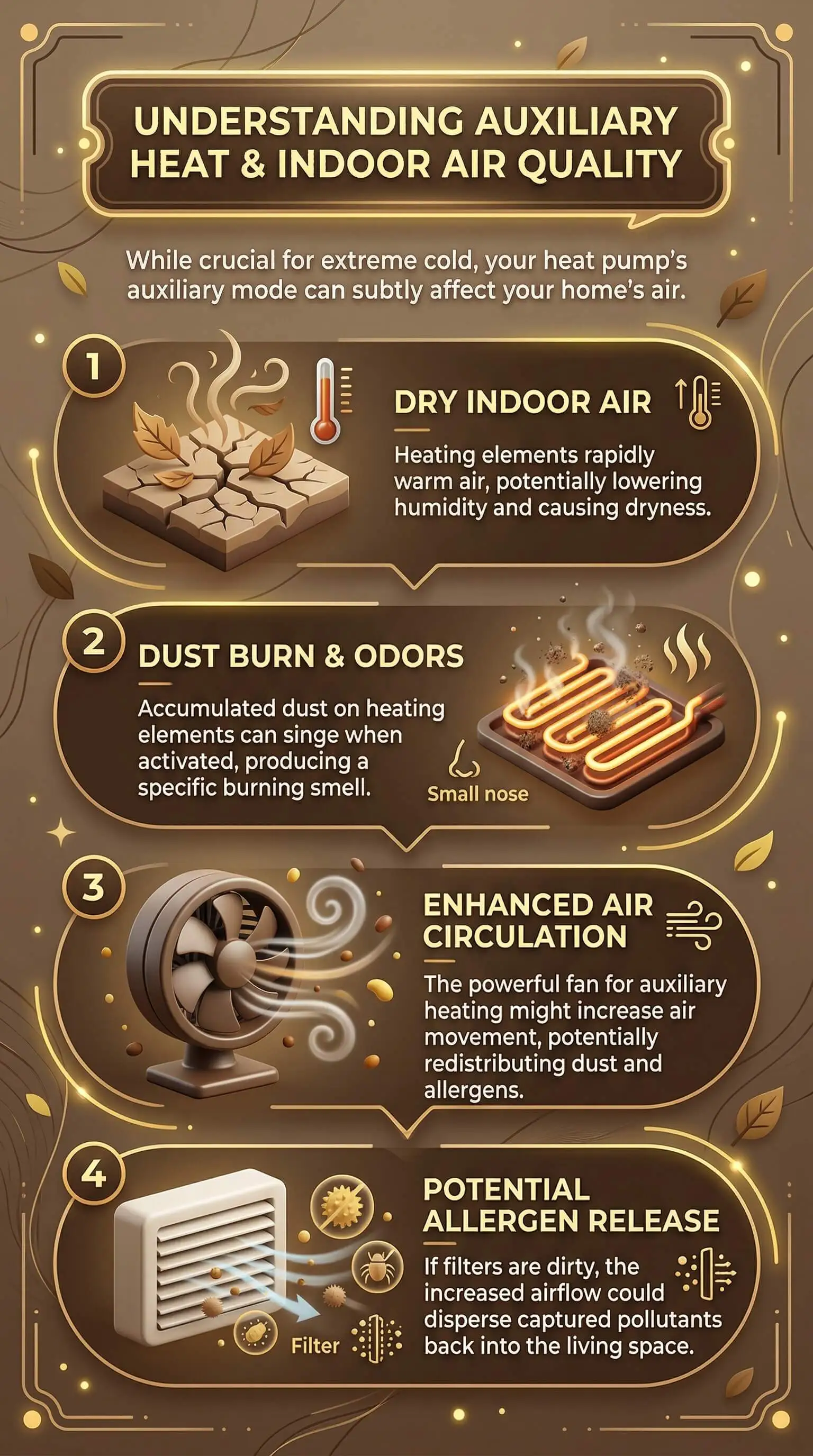
Auxiliary heat typically comes from electric resistance heating strips built into the air handler. When these strips activate, they generate intense, dry heat — and they push that heat through the same ductwork your system uses every day. That ductwork holds months, sometimes years, of accumulated dust, pet dander, mold spores, and fine debris. When auxiliary heat runs at higher temperatures and longer cycle times than normal operation, it dislodges and circulates those particles directly into your breathing spaces.
In our experience manufacturing air filters and supporting more than two million households, auxiliary heat cycles are one of the most predictable causes of sudden air quality decline during winter months.
How Auxiliary Heat Puts Additional Strain on Your Air Filter
Auxiliary heat doesn't just stir up particles — it accelerates filter loading. Here's what that means in practice:
Longer run cycles force more air volume through your filter in a shorter window
Higher heat output reduces relative humidity, which dries out particles and makes them lighter and easier to circulate
More frequent startups during cold snaps increase the rate at which debris becomes airborne
Dust and debris that were previously trapped in ductwork get pushed through at elevated velocity
The result is a filter that reaches capacity faster than expected — and a filter running past capacity stops protecting your home. What typically takes a month of normal operation can happen in days during a sustained cold stretch with heavy auxiliary heat use.
The Household Groups Most Affected
Not every home feels the impact equally. Based on what we see across our customer base, these households face the greatest air quality risk when auxiliary heat runs frequently:
Homes with pets, where dander accumulates faster in ductwork
Households with allergy or asthma sufferers, who are most sensitive to particulate spikes
Older homes with duct systems that haven't been cleaned recently
Homes with higher-rated MERV filters that may restrict airflow when loaded, forcing the system to work even harder
How to Protect Your Indoor Air Quality When Auxiliary Heat Is Active
You can't stop auxiliary heat from running — it's doing exactly what it's designed to do. But you can manage what it does to your air.
Check your filter more frequently during cold-weather months, not just on a fixed schedule
Upgrade to a MERV 11 or MERV 13 filter before winter sets in to capture finer particles circulated by longer run cycles
Monitor your home's humidity levels — auxiliary heat drives moisture out of the air, which compounds air quality and comfort issues
Schedule a duct inspection if your system is running auxiliary heat regularly and you haven't had ductwork serviced in several years
The filter you had in place last spring may not be the right filter for the demands auxiliary heat places on your system. After over a decade of manufacturing and seeing what winter puts homes through, we'd rather you know that now than after your air quality suffers.
"Most homeowners only think about their air filter when they remember to change it — but auxiliary heat changes the math entirely. We've seen filters that should last 30 days get completely loaded in under two weeks during a hard cold stretch. The heat strips run longer, the ductwork gets agitated, and suddenly your filter is working overtime against particles it was never meant to handle all at once. After manufacturing filters for over a decade and seeing what winter does to homes across the country, the most important advice we can give is simple: don't manage your filter on a calendar during the heating season. Manage it based on what your system is actually doing, especially before assuming your AC not working is the issue."
Essential Resources
1. Start Here: When Auxiliary Heat Is Normal — and When It's Telling You Something Is Wrong We put this guide together because it's one of the questions we hear most from homeowners in our community — and the answer matters more than most people realize. It walks you through what's triggering your aux heat, what's normal, and what genuinely needs attention before it becomes a bigger problem. https://hvac.filterbuy.com/resources/how-to-guides-and-hvac-maintenance/what-does-heat-on-auxiliary-mean-is-it-bad-if-aux-heat-comes-on-thermostat/
2. Straight from the DOE: How Your Heat Pump's Backup Heat Actually Works We always point homeowners to this one because it comes straight from the U.S. Department of Energy — and it confirms something we see in the field all the time: improper auxiliary heat operation is one of the most commonly violated heat pump installation practices. Worth reading before you call anyone for service. https://www.energy.gov/energysaver/air-source-heat-pumps
3. Is Your System Right for Your Climate? The DOE Explains Heat Pump Types and Efficiency From our years serving local families, we know that auxiliary heat runs harder in some climates than others — and this DOE guide helps you understand why. It covers system types, efficiency ratings, and regional considerations so you can make an informed decision, not just a reactive one. https://www.energy.gov/energysaver/heat-pump-systems
4. What the EPA Wants Every Homeowner to Know About Heat Pump Maintenance The EPA is straightforward about this: regular filter changes are one of the most important things you can do to keep your heat pump from overworking — and from triggering unnecessary auxiliary heat cycles. This is honest, authoritative guidance we genuinely stand behind. https://www.epa.gov/burnwise/heat-pumps
5. Thinking About an Upgrade? ENERGY STAR Breaks Down Certified Heat Pumps and Tax Credits If your auxiliary heat is running more than it should, it may be time to look at a more capable system. ENERGY STAR's guide covers certified heat pump performance at low outdoor temperatures and walks through available federal tax credits up to $2,000 — real savings that can make an upgrade much more manageable. https://www.energystar.gov/products/air_source_heat_pumps
6. Understanding Efficiency Standards — and What They Mean for Your System's Workload The U.S. Energy Information Administration explains the efficiency benchmarks your heat pump was built to meet. Knowing your system's HSPF rating helps you understand how hard it — and its auxiliary heat components — should realistically have to work to keep your home comfortable in cold weather. https://www.eia.gov/todayinenergy/detail.php?id=40232
7. The Full Picture: DOE's Complete Heat Pump Resource Hub When homeowners come to us wondering whether their auxiliary heat issues point to a sizing problem, an installation issue, or just normal wear, we often send them here first. The DOE's hub covers every heat pump type — air-source, geothermal, ductless, and dual-fuel — so you can have an informed conversation with your technician rather than starting from scratch. https://www.energy.gov/heat-pumps
Supporting Statistics
The numbers behind auxiliary heat and indoor air quality tell a story most homeowners never get to read. Here are three authoritative statistics that put what's happening inside your home into perspective.
Indoor pollutant concentrations can be 2 to 5 times higher than outdoors — and Americans spend roughly 90% of their time inside.
The U.S. Environmental Protection Agency confirms that Americans spend approximately 90% of their time indoors, where pollutant concentrations are often 2 to 5 times higher than outdoor levels. After manufacturing air filters for over a decade and supporting more than two million households, this is the statistic we come back to most — because it reframes the entire conversation around auxiliary heat.
Most homeowners think about aux heat as a thermostat issue. We think about it as an air quality issue. Here's why that distinction matters:
Auxiliary heat stirs up settled particles from your ductwork
Those particles don't disappear — they recirculate through your home
Your family spends nearly their entire day breathing that air
The result is a compounding exposure problem hiding behind a blinking thermostat indicator
Source: U.S. Environmental Protection Agency — Indoor Air Quality https://www.epa.gov/report-environment/indoor-air-quality
Space heating and cooling account for more than half of the average U.S. household's annual energy consumption.
The U.S. Energy Information Administration reports that space heating and air conditioning together represent 52% of a typical household's total annual energy use. Your HVAC system isn't just the most energy-intensive system in your home — it's the system moving the most air across your filter, day in and day out.
What that means in practice when auxiliary heat runs:
Air volume through your ductwork increases significantly
Run cycles extend well beyond normal operation
Filter loading accelerates faster than most homeowners expect
A filter adequate for normal operation may not be adequate for sustained cold-weather demands
In our experience, that gap between what a filter can handle and what a system is actually asking it to do is where winter air quality problems quietly begin.
Source: U.S. Energy Information Administration — Use of Energy in Homes https://www.eia.gov/energyexplained/use-of-energy/homes.php
Asthma affects more than 25 million Americans — including an estimated 5 million children — and indoor air quality is one of the most controllable contributing factors.
The EPA identifies asthma as a serious, sometimes life-threatening chronic respiratory disease. Families with asthma sufferers are often the ones most blindsided by winter air quality changes — not because they're unprepared, but because no one told them that auxiliary heat changes the filtration equation entirely.
When auxiliary heat runs hard during cold stretches, the impact is direct:
Longer run cycles dislodge dust mites, pet dander, and mold spores from ductwork
Particles circulate at elevated velocity through living spaces
The most vulnerable members of the household absorb the highest exposure
Two steps that make a measurable difference before heating season begins:
Upgrade to a MERV 11 or MERV 13 filter before temperatures drop
Check your filter more frequently during cold stretches — not on a fixed calendar schedule
Source: U.S. Environmental Protection Agency — Indoor AirPlus and Asthma https://www.epa.gov/indoorairplus/indoor-airplus-and-asthma
Final Thoughts
Most conversations about auxiliary heat start and end with energy bills. After manufacturing air filters for over a decade and seeing what winter does to homes across the country, we believe the more important conversation is the one almost nobody is having: what auxiliary heat does to the air your family breathes.
Auxiliary heat isn't the problem — inadequate filtration is.
Aux heat is doing exactly what it was designed to do. The problem is that most homes aren't set up to handle what it demands from their filtration. The filter that worked in October is rarely the right filter for a hard January cold snap.
What we've observed consistently across two million households:
Homeowners who struggle most with winter air quality aren't neglecting their homes — they're maintaining them on the wrong schedule
The gap between a filter's capacity and a system's demand during heavy aux heat use is where the problem lives
That gap stays invisible until someone in the household starts noticing symptoms — increased allergy flare-ups, more dust on surfaces, air that feels stale or dry
Our take is straightforward.
Auxiliary heat deserves a place in your seasonal home maintenance plan — the same way furnace tune-ups and gutter cleaning do. Here's what that looks like in practice:
Check your filter before heating season begins — not when you remember to
Upgrade your MERV rating if your household includes pets, allergy sufferers, or young children
Monitor filter condition during cold stretches rather than trusting a fixed calendar schedule
The families who breathe the best air in winter aren't the ones with the most sophisticated systems. They're the ones who understand that when their system works harder, their filter needs to keep up. That's not a complicated standard to meet — but it does require knowing it exists in the first place.
FAQ on What Does Auxiliary Heat Mean
Q: What does auxiliary heat mean on my thermostat?
A: Auxiliary heat — displayed as "Aux Heat" — is your heat pump's built-in backup heating system. It activates automatically when outdoor temperatures drop too low for your heat pump to work alone.
What "Aux Heat" on your thermostat means:
It is not a warning light or a malfunction
Short bursts during cold weather are completely normal
Constant operation is the signal that warrants a closer look
After serving more than two million households, Aux Heat is one of the most misread indicators in home HVAC. Short bursts are expected. Constant operation means something needs attention.
Q: When does auxiliary heat turn on?
A: Auxiliary heat activates under three predictable conditions:
Outdoor temperatures fall below 30°F to 35°F — the range most heat pumps handle efficiently
Your thermostat is raised several degrees at once, and the heat pump needs backup to catch up
Your heat pump enters a defrost cycle to clear ice buildup on the outdoor unit
Pro tip: Raising your thermostat one to two degrees at a time — rather than several degrees at once — prevents most unnecessary auxiliary heat activation before it starts.
Q: Is auxiliary heat the same as emergency heat?
A: No. The difference is important:
Auxiliary heat — activates automatically alongside your heat pump when conditions demand it
Emergency heat — bypasses your heat pump entirely and runs solo
When to use emergency heat:
Only when your heat pump is damaged or completely inoperable
Using emergency heat when your heat pump is still functional is one of the fastest ways to drive up energy costs unnecessarily.
Q: Does auxiliary heat affect indoor air quality?
A: Yes — and it is one of the most overlooked air quality triggers we encounter. Here is what happens when auxiliary heat runs:
Your system runs hotter and longer than normal
Settled dust, pet dander, and mold spores dislodge from ductwork
Those particles push directly into your living spaces
Filter loading accelerates — what takes 30 days normally can happen in under two weeks
Three steps to protect your air quality during auxiliary heat season:
Check your filter before heating season begins
Upgrade to a MERV 11 or MERV 13 filter if your household is high-risk
Inspect your filter based on system workload — not a fixed calendar schedule
Q: How do I stop auxiliary heat from running constantly?
A: Constant auxiliary heat usually points to something fixable. Start here:
Adjust your thermostat gradually — raise temperature one to two degrees at a time to prevent unnecessary activation
Check your air filter — a clogged filter restricts airflow and forces your system to overwork. This is the fix that makes the biggest difference most frequently
Seal drafts and improve insulation — heat escaping through walls and windows forces continuous system compensation
Schedule a professional inspection — persistent aux heat operation often indicates refrigerant issues, faulty defrost controls, or an undersized system
When to call a professional:
Auxiliary heat runs constantly regardless of outdoor temperature
Your energy bill spikes without explanation
Your system runs long cycles but never reaches your set temperature
Don't wait for your energy bill to confirm what your thermostat is already telling you.
Protect Your Home's Air Quality This Heating Season
Now that you understand how auxiliary heat affects the air your family breathes, the next step is making sure your filter is ready to handle it. Shop Filterbuy's MERV 11 and MERV 13 air filters today and stay ahead of what heating season puts your home through.