Most first-time buyers inherit that decision without knowing it. After working across hundreds of Central Florida homes, the pattern is consistent: the system at closing was sized by someone else, installed by someone else, and maintained — or not — by someone else. What we've learned from that work is in this guide.
What you'll find here:
How to evaluate the HVAC system in any home before closing
What Altamonte Springs' hot-humid climate actually demands from a properly installed system
The four installation standards that determine performance and air quality from day one
How to verify contractor credentials before the first conversation
What a complete installation costs in this market — and which financial resources first-time buyers most commonly miss
One thing experience in this market has made clear: top HVAC system installation near Altamonte Springs FL is what separates a home that’s comfortable and affordable to cool from one that isn’t. It rarely comes down to equipment brand. It comes down to whether the system was installed correctly for this climate and this home. That's what this guide is built around.
TL;DR Quick Answers
HVAC Installation Guide for First-Time Homebuyers in Altamonte Springs
The most important thing first-time buyers in this market need to know: the system in the home at closing was installed by someone else, sized by someone else, and maintained — or not — by someone else. What that history looks like determines what the next 15 years look like.
Four questions to ask before any offer is made:
Was a Manual J completed? — Square footage estimates produce oversized systems that short-cycle without controlling humidity
Was the ductwork assessed and leakage-tested? — Unassessed ductwork in pre-1990 Seminole County homes commonly leaks 20–30% of conditioned air
Is there a mechanical permit on file? — A missing permit means no inspection, no verification, and no recourse
Is there a documented service history? — No paper trail from installation day is a replacement conversation waiting to happen
If you're replacing the system:
Verify contractor license at myfloridalicense.com before the first conversation
Complete the Duke Energy Home Energy Check before equipment is ordered — up to $1,000 in rebates require it
Confirm IRS Section 25C eligibility — up to $2,000 on qualifying heat pumps
Insist on written post-installation documentation before the technician leaves
In Altamonte Springs, air conditioning runs 10+ months per year and accounts for 28% of total home energy use — more than four times the national average. Getting the installation right matters more here than almost anywhere else in the country. Getting it wrong compounds on every utility bill for the life of the system.
Top Takeaways
The Installation Decision Matters More Than the Equipment Decision — Brand, SEER2 rating, and warranty terms operate within the ceiling installation quality sets. A high-efficiency system installed without a Manual J, connected to unassessed ductwork, and never verified for airflow will underperform a mid-tier system installed correctly. The equipment gets blamed. The installation was the problem from day one.
Four Non-Negotiables Separate a Quality Installation From One That Will Cost You — Before any system is connected, four steps determine everything that follows:
Manual J load calculation completed for the actual home — not estimated from square footage
Existing ductwork assessed and leakage-tested before new equipment is scheduled
Refrigerant charged to manufacturer specs with calibrated, documented gauges
Post-installation airflow confirmed and documented before the technician leaves
Skip any one step and the system runs at a deficit from day one.
Florida's Climate Makes Every Installation Shortcut More Expensive Than Anywhere Else — Air conditioning accounts for 28% of total Florida home energy use vs. 9% nationally. Altamonte Springs systems run 10+ months per year. A 20–30% efficiency loss from improper installation compounds across every billing cycle for the life of the system. The financial tail of a skipped installation step is longer here than almost anywhere else in the country.
Your HVAC System Doesn't Just Affect Indoor Air Quality — In This Climate, It Is Indoor Air Quality — EPA research confirms indoor pollutant concentrations are 2–5 times higher inside homes than outside. In Altamonte Springs:
Oversized systems short-cycle without completing humidity removal — leaving indoor humidity above 60%, the threshold Florida DOH identifies as favorable to mold growth
Leaking return ducts pull attic contaminants into living spaces with every cooling cycle
Insufficient airflow makes filtration ineffective regardless of filter MERV rating
A properly installed system controls humidity, airflow, and filtration simultaneously. An improperly installed one actively worsens all three.
Verify the License and Ask for the Documentation — Before Any Other Conversation — Four steps before any estimate:
Check active Florida mechanical contractor license at myfloridalicense.com
Ask for Manual J documentation methodology before discussing equipment
Confirm ductwork will be assessed and leakage-tested before connection
Verify Seminole County mechanical permit will be pulled as standard
An unlicensed installation voids manufacturer warranties and creates liability at resale. Contractors who answer those questions without hesitation are the ones whose installations don't generate callbacks.
Buying your first home in Altamonte Springs means inheriting an HVAC system with a history you weren't part of. Before closing, three questions determine whether that system is an asset or a liability:
How old is the system and what is its documented service history?
Was it sized with a Manual J load calculation or estimated from square footage?
When was the ductwork last assessed and leakage-tested?
Most sellers don't have complete answers. That gap is information. A system with no documented maintenance history, unknown sizing methodology, and unassessed ductwork is a replacement conversation waiting to happen — the only question is when.
What Altamonte Springs' Climate Demands From a Properly Installed System
Central Florida's hot-humid climate is one of the most demanding operating environments for residential HVAC in the country. Altamonte Springs systems run 10 or more months per year against heat, humidity, and afternoon thunderstorm cycles that stress equipment continuously.
Three climate-specific demands separate a properly installed system from one that will underperform here:
Humidity control — correct sizing ensures the system runs full cycles long enough to remove moisture, not just cool air temperature
Consistent airflow — assessed, sealed ductwork delivers conditioned air where it's designed to go instead of pressurizing attic and wall cavities
Effective filtration — verified airflow rates confirm the system is actually moving air through the filter at the rate required to capture contaminants
An oversized system short-cycles. It cools the air quickly, shuts off before completing humidity removal, and leaves indoor humidity above 60% — the threshold the Florida Department of Health identifies as favorable to mold growth. In this climate, a system that cools the air but doesn't control humidity isn't doing its job.
The Four Installation Standards That Determine Long-Term Performance
From completing installations across Seminole County, four standards consistently separate systems that perform well for 15 years from ones that generate ongoing service calls, comfort complaints, and air quality problems.
1. Manual J Load Calculation System size must be determined by the home's actual characteristics — insulation levels, window orientation, ceiling height, sun exposure, and local climate data. Square footage estimates produce oversized systems that short-cycle and undersized systems that run continuously. Neither controls humidity in this climate.
2. Duct Assessment and Leakage Testing Existing ductwork must be assessed and leakage-tested before any new equipment is connected. Ductwork leaking 20–30% of conditioned air — common in pre-1990 Seminole County construction — transfers that loss directly to system performance and utility costs. A new high-efficiency system connected to leaking ductwork will never perform to its rated efficiency.
3. Refrigerant Charge Verification Refrigerant must be charged to manufacturer specifications using calibrated, documented gauges — not estimated. An incorrect charge of as little as 10% reduces system efficiency measurably and accelerates compressor wear. This step requires documentation before the technician leaves.
4. Post-Installation Airflow Confirmation Airflow must be measured and confirmed against design specifications after installation is complete. This is the verification step that confirms everything else worked. Without it, installation faults go undetected until they surface on utility bills and service records.
How to Verify a Contractor Before the First Conversation
Florida Statute 489 requires a licensed mechanical contractor and a pulled permit for every residential HVAC installation. Both protect the homeowner — not the contractor.
Three verification steps before any estimate:
Check the active Florida mechanical contractor license at myfloridalicense.com — takes two minutes
Confirm the contractor pulls Seminole County mechanical permits as standard practice — not on request
Ask for Manual J documentation methodology before discussing equipment — the answer tells you everything about how the installation will be approached
An unlicensed installation voids manufacturer warranties and creates liability at resale. A missing permit means no inspection, no verification, and no recourse if something goes wrong — which is why working with an HVAC installation specialist matters.
What HVAC Installation Costs in Altamonte Springs — and How to Reduce It
Most first-time buyers in this market pay $5,000–$12,000 for a complete system replacement. Homes requiring ductwork repair or replacement typically run $8,000–$15,000.
Three financial resources most first-time buyers miss by not planning ahead:
Duke Energy rebates — up to $1,000 on qualifying equipment, requires a Home Energy Check completed before installation
IRS Section 25C tax credit — up to $2,000 on qualifying heat pumps, up to $600 on qualifying central AC systems
DSIRE database — additional state and utility incentives searchable by ZIP code at dsireusa.org
The consistent pattern from working with first-time buyers in this market: rebate prerequisites get discovered after equipment is already ordered. Confirming eligibility before scheduling installation is the difference between accessing that money and losing it entirely. For a first-time buyer absorbing closing costs and move-in expenses simultaneously, that's a meaningful number to leave on the table.
"After working across hundreds of Altamonte Springs homes, the most expensive HVAC mistake we see first-time buyers make isn't choosing the wrong equipment — it's inheriting a system with no documented sizing methodology and no ductwork history, then replacing it under pressure in July when the leverage is gone and the sequence that protects long-term performance gets compressed into a single afternoon. The installation decisions made on day one of homeownership set the ceiling for every utility bill, every air quality outcome, and every repair call for the next 15 years. Getting that sequence right before closing costs nothing. Getting it wrong after closing costs everything."
Essential Resources
1. Verify Your Florida Contractor License Before the First Conversation — It Takes Two Minutes
Florida DBPR — License Verification https://www2.myfloridalicense.com
From working across Altamonte Springs homes, this is the one step we'd never skip ourselves — and we'd tell any neighbor the same thing. Search any Florida mechanical contractor by name or license number, confirm active status, and then have the rest of the conversation. Everything else comes after.
2. Know Exactly What a Quality Installation Requires Before You Agree to Anything
ENERGY STAR — HVAC Quality Installation https://www.energystar.gov/saveathome/heating-cooling/hvac-quality-installation
We've seen what happens when these steps get skipped — and it's never discovered on installation day. EPA's defined quality installation standards cover duct leakage testing, airflow verification, and refrigerant charge documentation. Read this before any contractor visit so you know what to ask for and what to expect.
3. Make Sure Your Seminole County Permit Is Pulled Before Installation Day — Not After
Seminole County Building Division — Building Permits Online https://www.seminolecountyfl.gov/departments-services/development-services/building
Every residential HVAC installation in Seminole County requires a pulled mechanical permit and a passed inspection — homeowners can verify permit status on any property online, seven days a week. As your neighbors in this community, we pull permits on every job without being asked because it protects you, not us.
4. Complete the Duke Energy Home Energy Check Before Equipment Is Ordered — This Is the Step Most Altamonte Springs Homeowners Miss
Duke Energy Florida — HVAC Replacement Rebate https://www.duke-energy.com/Home/Products/Home-Energy-Improvement/HVAC-Replacement?jur=FL01
Duke Energy offers up to $1,000 back on qualifying HVAC replacements for Altamonte Springs homeowners — but the Home Energy Check must be completed before installation begins. We've had neighbors reach out after equipment was already ordered and the rebate window had closed. Don't let that be you. Schedule the check first.
5. Claim the IRS Section 25C Tax Credit for the Year Your System Is Installed — Not the Year You Think About It
IRS — Energy Efficient Home Improvement Credit https://www.irs.gov/credits-deductions/energy-efficient-home-improvement-credit
A federal tax credit worth up to $2,000 on qualifying heat pump installations and up to $600 on qualifying central AC systems — filed for the tax year the system goes in, using IRS Form 5695. This is money that resets annually with no lifetime limit, and it's money we want every Altamonte Springs homeowner to actually keep.
6. Search Every Florida Incentive Available to You by ZIP Code Before You Set a Budget
DSIRE — Florida Energy Efficiency Incentives https://programs.dsireusa.org/system/program/fl
The most comprehensive database of state, utility, and federal energy efficiency incentives in the country — searchable by ZIP code and incentive type. Altamonte Springs homeowners regularly qualify for multiple overlapping incentives beyond Duke Energy and the IRS credit. Search here before budgeting, not after, because what you find often changes the conversation entirely.
7. Understand What Florida's Climate Requires From Any HVAC System Before Selecting Equipment
Florida Department of Health — Indoor Air Quality and Mold https://www.floridahealth.gov/environmental-health/mold/index.html
Living and working in this community, we know firsthand that humidity control isn't a comfort preference here — it's a health concern. Florida DOH guidance confirms that indoor humidity above 60% creates conditions favorable to mold growth, which is exactly what happens when an oversized system short-cycles without completing humidity removal. Read this before any equipment is selected so you understand what you're actually asking your system to do.
These essential resources help Altamonte Springs homeowners confidently plan a top HVAC installation service by verifying licensing and permits, understanding ENERGY STAR quality-install requirements, and capturing every available rebate, tax credit, and humidity-control standard before equipment is selected.
Supporting Statistics
More Than 65% of Residential HVAC Systems Are Improperly Installed — and the Consequences Start on Day One
This is the statistic we think about on every job. After years of completing installations across Altamonte Springs, we've watched it play out consistently — not as an industry abstraction, but as a pattern in real homes with real utility bills.
U.S. Department of Energy and NREL research confirms:
More than 65% of residential HVAC systems are improperly installed
Improperly installed systems consume 20–30% more energy than necessary
Installation faults waste up to 1.6 quadrillion BTU annually across U.S. homes
What our experience in this market adds to that number:
The three faults we encounter most often mirror exactly what the research identifies: incorrect refrigerant charge, insufficient airflow across the indoor coil, and undetected duct leakage
None of these faults announce themselves on installation day — all three surface on utility bills, service records, and comfort complaints homeowners typically blame on equipment
In Altamonte Springs, a 20–30% efficiency penalty operating 10+ months per year compounds across a 15-year lifespan in ways a 4–5 month cooling market never experiences
The homes with the most persistent problems weren't always the oldest or cheapest — they were homes where one installation fault was present from day one and never corrected
A system installed correctly performs as rated for its full lifespan. One installed with any of these faults never does — regardless of brand, efficiency tier, or warranty.
Source: U.S. Department of Energy — Optimizing the Installed Performance of Residential HVAC Systems https://www.energy.gov/eere/buildings/articles/optimizing-installed-performance-residential-hvac-systems
Supporting: U.S. Department of Energy — Residential HVAC Installation Practices: A Review of Research Findings https://www.energy.gov/eere/buildings/articles/residential-hvac-installation-practices-review-research-findings
Air Conditioning Accounts for 28% of Total Home Energy Use in Florida — More Than Four Times the National Average
We don't cite this statistic to make a point about energy efficiency in the abstract. We cite it because it explains something we see in Altamonte Springs homes every season: the financial consequences of an improperly installed system are measurably larger here than almost anywhere else in the country.
EIA's Residential Energy Consumption Survey confirms:
Air conditioning accounts for 28% of total site energy in Florida homes vs. 9% nationally
Florida's residential sector consumes more electricity than any other sector in the state
96% of Florida households use air conditioning — 90% rely on central systems
What working in this market specifically has taught us:
A 20–30% efficiency loss operating 4–5 months per year is one number — that same loss operating 10+ months per year across a 15-year system lifespan is a number that changes the entire contractor selection conversation
Every skipped installation step has a longer financial tail in this climate than almost anywhere else in the U.S.:
Unverified refrigerant charge — efficiency loss from day one
Unassessed duct system — conditioned air delivered to attic cavities, not living spaces
Manual J replaced with a square footage estimate — system sized for a generic home, not yours
Getting installation right here isn't just a performance decision — it's a financial commitment that renews on every utility bill for the life of the system
Source: U.S. Energy Information Administration — Air Conditioning Accounts for About 12% of U.S. Home Energy Expenditures https://www.eia.gov/todayinenergy/detail.php?id=36692
Supporting: U.S. Energy Information Administration — Florida State Energy Profile https://www.eia.gov/state/print.php?sid=FL
Indoor Pollutant Levels Are 2–5 Times Higher Inside Your Home Than Outside — Your HVAC System Is the Primary Variable
This is the statistic that reframes the entire installation conversation. When we share it with Altamonte Springs homeowners, the reaction is almost always the same: they came in thinking about temperature and left thinking about what their family is actually breathing.
EPA's TEAM studies confirm:
Common indoor pollutant concentrations are 2–5 times higher inside homes than outside — regardless of rural or industrial location
Americans spend approximately 90% of their time indoors
High temperatures and humidity directly increase indoor pollutant concentrations — the baseline condition in Altamonte Springs for most of the year
A properly installed system controls the three mechanisms that determine what your family breathes every day:
Humidity removal — correct sizing ensures full-cycle operation long enough to extract moisture, not just drop the temperature
Airflow consistency — assessed, sealed ductwork delivers conditioned air where designed, instead of pulling attic contaminants into living spaces
Filtration effectiveness — verified airflow rates confirm the system is moving air through the filter at the rate required to capture particles
An improperly installed system actively worsens that 2–5x indoor pollution multiplier:
Oversized systems short-cycle before completing humidity removal — leaving indoor humidity above 60%, the threshold Florida DOH identifies as favorable to mold growth
Leaking return ducts pull unconditioned attic air — dust, biological material, insulation particles — into every room with every cooling cycle
Insufficient airflow makes filtration largely irrelevant regardless of filter MERV rating
From years of assessments across Seminole County homes, the air quality complaints we hear most often — persistent musty odors, worsening allergy symptoms, visible dust accumulation — almost always trace back to one of these three installation failures.
In this climate, the HVAC system isn't a tool that supports indoor air quality. It is indoor air quality. Installation quality determines which direction the air in your home moves.
Source: U.S. EPA — The Inside Story: A Guide to Indoor Air Quality https://www.epa.gov/indoor-air-quality-iaq/inside-story-guide-indoor-air-quality
Supporting: U.S. EPA — Indoor Air Quality https://www.epa.gov/report-environment/indoor-air-quality
Supporting: Florida Department of Health — Mold and Indoor Air Quality https://www.floridahealth.gov/environmental-health/mold/index.html
Final Thought
Most HVAC installation conversations start in the wrong place.
Homeowners research equipment brands. They compare SEER2 ratings. They sort estimates by price. All understandable — but none of it is the decision that determines how the system performs, what utility bills look like, or what the family inside the home is breathing for the next 15 years.
That decision happens before any equipment is selected. It happens in the conversation about:
Whether a Manual J will be completed before any equipment is recommended
Whether existing ductwork will be assessed and leakage-tested before anything is connected
Whether refrigerant charge will be documented with calibrated gauges
Whether a Seminole County mechanical permit will be pulled without being asked
Whether post-installation airflow will be verified and documented before the technician leaves
That's the decision. Everything else — brand, efficiency tier, warranty — operates within the ceiling that decision sets.
Here's the opinion we've formed after years of working in this community:
Homeowners who ask those questions before signing almost never call back with problems. Homeowners who don't — who choose on price or availability or under the pressure of a system that failed in July — are the ones whose service histories tell a different story. Not because they made a careless decision. Because no one gave them the framework to ask the right questions before urgency made the conversation a different one entirely.
That framework is what this page is built around. After years of completing installations across Altamonte Springs and Seminole County, here's what experience has made clear:
The climate here is unforgiving to installation shortcuts in ways most U.S. markets aren't
The financial consequences of a poorly installed system compound longer here than almost anywhere else in the country
The indoor air quality consequences — musty odors, worsening allergy symptoms, mold conditions — almost always trace back to a step skipped on installation day
Every one of those outcomes was preventable — not with better equipment, but with a complete installation process from a contractor who did the work correctly from the start
Altamonte Springs deserves installations done completely, correctly, and without shortcuts.
Filterbuy HVAC Solutions serves this community with:
Licensed technicians and pulled Seminole County mechanical permits on every job
Manual J load calculations completed before any equipment is selected
Full duct assessments and leakage testing before any new system is connected
Refrigerant charge verified to manufacturer specifications with documented gauges
Post-installation airflow confirmation and written documentation before the technician leaves
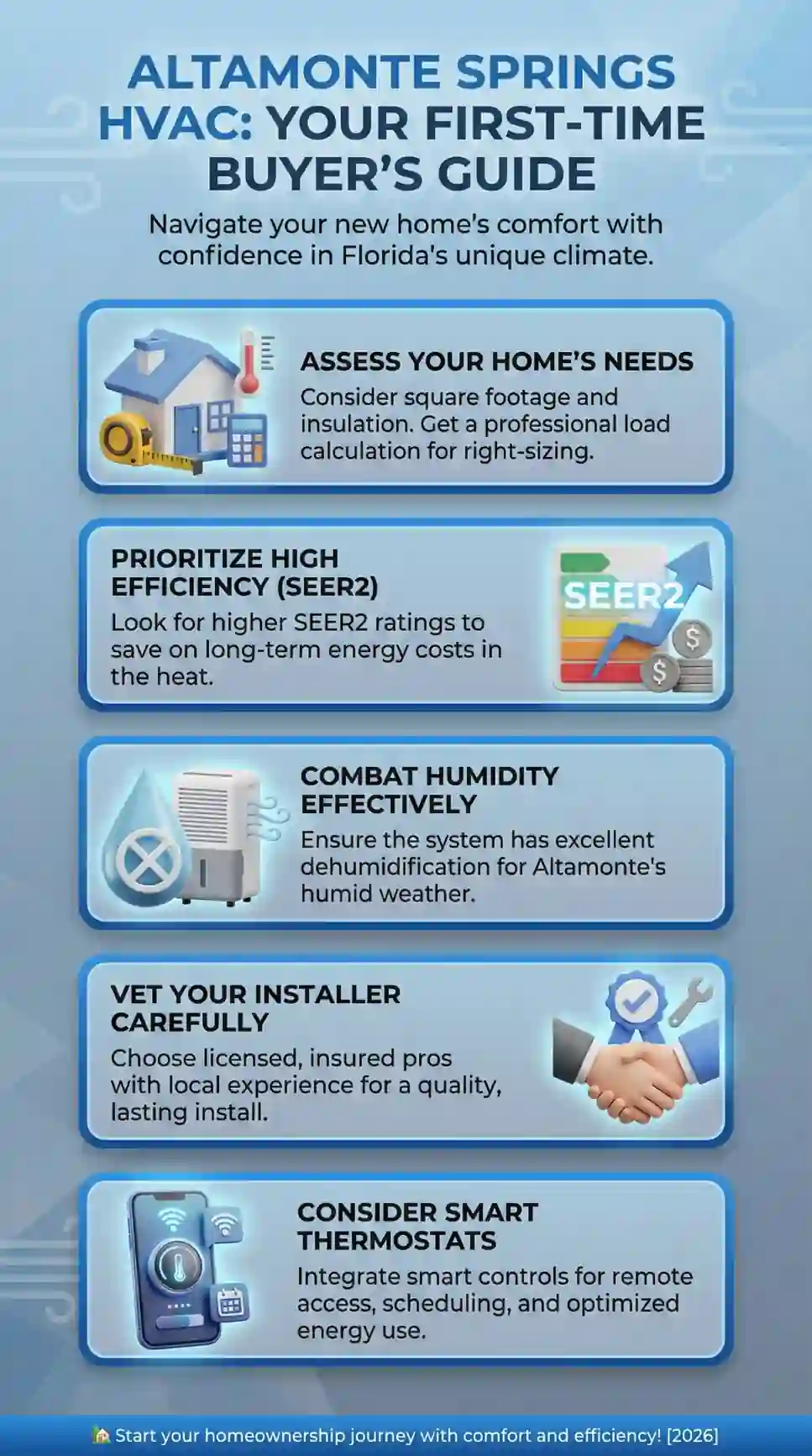
FAQ on HVAC Installation Guide for First-Time Homebuyers in Altamonte Springs
Q: How do I evaluate the HVAC system in a home I'm considering buying in Altamonte Springs?
A: Before any offer is made, four questions determine whether the system is an asset or a liability:
How old is the system and what does the documented service history show?
Was it sized with a Manual J load calculation or a square footage estimate?
When was the ductwork last assessed and leakage-tested?
Are mechanical permits on file for the original installation and any subsequent work?
Most sellers won't have complete answers. That gap is information.
From walking through hundreds of Altamonte Springs homes, the systems that generate the most persistent problems aren't always the oldest ones. They're the ones with no paper trail from installation day. A system without sizing documentation, permit records, or service history is a replacement conversation waiting to happen. The only question is whether it happens before closing or after.
Q: What does Altamonte Springs' climate require from a properly installed HVAC system that other markets don't?
A: Three demands this climate places on every installed system — and that most installations we've assessed have never fully addressed:
Humidity control — Systems must run full cycles long enough to remove moisture, not just drop air temperature. Oversized systems short-cycle before completing humidity removal, leaving indoor humidity above 60% — the threshold Florida DOH identifies as favorable to mold growth. In Altamonte Springs, uncontrolled humidity isn't a comfort issue. It's a healthy one.
Consistent airflow — Assessed, sealed ductwork ensures conditioned air reaches living spaces instead of pressurizing attic cavities. Ductwork leaking 20–30% of conditioned air — common in pre-1990 Seminole County construction — transfers that loss to performance and utility costs every month the system runs.
Effective filtration — Post-installation airflow verification confirms the system is moving air through the filter at the rate required to capture contaminants. Without that step, filtration is largely theoretical regardless of MERV rating.
The homes across this market that stay comfortable, affordable, and healthy long-term had all three demands addressed on installation day — not identified years later during a service call.
Q: What should first-time homebuyers in Altamonte Springs know about HVAC installation costs and available financial resources?
A: Most Altamonte Springs homeowners pay $5,000–$12,000 for a complete replacement. Homes with ductwork needs typically run $8,000–$15,000.
The number that surprises most first-time buyers isn't the installation cost. It's how much money was available and missed because prerequisites weren't confirmed before equipment was ordered.
Three resources to confirm before scheduling anything:
Duke Energy rebates — up to $1,000 on qualifying HVAC replacement; Home Energy Check must be completed before installation begins — not after
IRS Section 25C tax credit — up to $2,000 on qualifying heat pumps, up to $600 on qualifying central AC; claimed for the tax year the system is installed using IRS Form 5695
DSIRE database — additional state and utility incentives searchable by ZIP code at dsireusa.org; frequently surfaces overlapping incentives Duke Energy and the IRS credit don't capture individually
The rebate window closes quietly. Equipment gets ordered. Installation gets scheduled. The prerequisite that needed to happen first gets discovered afterward. For a buyer absorbing closing costs and move-in expenses, confirming eligibility before scheduling is the difference between accessing that money and losing it entirely.
Q: How do I verify an HVAC contractor before scheduling an installation in Altamonte Springs?
A: Four steps — in this order — before any estimate is discussed:
Verify the active Florida mechanical contractor license at myfloridalicense.com — two minutes that determine whether the rest of the conversation is worth having
Confirm Seminole County mechanical permits are pulled as standard — not on request, not as an add-on, not something that requires asking twice
Ask for Manual J documentation methodology before any equipment discussion — how a contractor answers this question reveals how the entire installation will be approached
Ask about post-installation verification — confirm airflow will be measured, refrigerant charge documented, and written documentation provided before the technician leaves
From years of working in this market, the contractors who answer all four without hesitation are the ones whose installations don't generate callbacks. The ones who hedge or redirect are telling you something important before the first tool is unpacked.
Q: What are the most common HVAC installation mistakes first-time homebuyers inherit in Altamonte Springs — and how do you identify them?
A: From assessments across Seminole County homes, four failures appear most consistently — none of them visible on move-in day:
Oversized equipment sized from square footage — short-cycles before completing humidity removal; shows up as persistent indoor humidity, musty odors, and rooms that feel clammy despite the system running
New equipment connected to unassessed ductwork — leaking return ducts pull unconditioned attic air into living spaces with every cooling cycle; shows up as excessive dust, uneven room temperatures, and utility bills that don't match the system's efficiency rating
Unverified refrigerant charge — a variance of as little as 10% reduces efficiency and accelerates compressor wear; shows up as longer cooling cycles and compressor failures earlier than expected
No post-installation airflow verification — filtration becomes ineffective regardless of MERV rating; shows up as worsening allergy symptoms and air quality complaints that persist through filter changes
None of these surface on installation day. All surface on utility bills, service records, and in conversations about why the system that came with the house never performed the way it should.
If you're inheriting a system with no documentation — no Manual J, no permit record, no service history — budget for a professional assessment before closing. What that assessment costs is a fraction of what discovering those answers after closing typically does.
In HVAC Installation Guide for First-Time Homebuyers in Altamonte Springs, we emphasize that a “good install” isn’t just the equipment—it’s the airflow, humidity control, and filtration choices you can realistically maintain after move-in. That’s why we recommend confirming the correct filter size and rating for your new system, like a 16x20x1 MERV 11 air filter to support cleaner indoor air without choking airflow, a properly matched 20x25x6 MERV 8 HVAC air filter for systems that use thicker media cabinets, and a reliable 14x20x2 pleated HVAC furnace filter to help reduce dust and allergens while keeping static pressure in check. Pairing a quality installation with the right filtration setup helps first-time homeowners in Altamonte Springs protect comfort, control humidity, and keep their new system performing the way it was designed to.