TL;DR Quick Answers
top HVAC system repair near Clermont FL
In our experience, the top HVAC repair contractors near Clermont FL hold a current Florida DBPR license (searchable at MyFloridaLicense.com), maintain EPA Section 608 certification for refrigerant work, and provide a written diagnosis with pressure readings before quoting any repair. Anything missing is a signal to get a second opinion.
Top Takeaways
Capacitors and contactors account for most Clermont AC repair calls. They're also usually the cheapest fix on the list.
A refrigerant top-off without a leak search violates EPA Section 608 and doesn't fix anything anyway.
Original 34711 systems from the 1990s fail differently than newer 34714 heat pumps. Your repair pricing should reflect that.
Verify any contractor's Florida DBPR license at MyFloridaLicense.com before authorizing any work.
A 30-day filter cadence through oak pollen season and peak humidity prevents more repairs than any other single thing a homeowner does.
Spring tune-ups in March or early April catch failing parts before the August breakdown wave.
A real diagnosis comes with paperwork. If the technician didn't write down pressure readings or amp draws, what you got was a sales pitch with a wrench.
Why HVAC Repairs Run Higher Here Than the Florida Average
Clermont sits in Lake County hill country, the highest terrain in peninsular Florida, which on paper should mean cooler air and lower humidity than the rest of the state. We've found that the elevation matters less than the load. From May through September your system runs nearly continuously, and the attic space where most residential air handlers live will hit 130 to 140°F by 2 PM. Every part inside that box (capacitor, blower motor, control board) is working in temperatures the manufacturer never spec'd around when the house was built.
Then there's what happens outside the equipment. Duke Energy rates here run above the Florida average, which means a degraded system shows up on your power bill weeks before it ever shows up as a breakdown. The housing mix matters too. Original 34711 neighborhoods around Lake Minneola and the South Lake Hospital area went up mostly in the 1990s with flex ducts that's well past its design life. Newer construction off Hancock Road in 34714 leans toward heat pumps and tighter envelopes, which behave differently when something goes wrong. That’s why quality HVAC repair in Clermont requires local experience, because the right contractor understands how different home styles, duct systems, and Florida climate conditions affect comfort, efficiency, and long-term system performance across each part of the area. Honestly, we see different repairs in different ZIP codes, and the price you're quoted should reflect that.
The Five Repairs Clermont Homeowners Pay For Most Often
Five repairs account for the bulk of what we see on Clermont service calls, and being able to tell them apart can save a homeowner from approving the wrong fix in a panic.
1. Capacitor or contactor failure. This is the most common Clermont AC repair we see and usually the cheapest . The capacitor is a small electrical part that gives your compressor and blower motor the kick they need to start running. When it fails, the unit hums but won't start, or the outdoor fan stays still while the compressor runs hot and pulls amperage it shouldn't. A contractor who knows what he's doing has this fixed in under an hour with a part he should already have on the truck.
2. Refrigerant leak repair. A low refrigerant charge means your system is leaking. It's a symptom, not the actual problem. Federal rules under EPA Section 608 require any technician handling refrigerant to be certified, and they shouldn't legally top off a leaking system without finding and repairing the leak first. If a contractor offers to "just add a little" without checking pressures, dye-testing the indoor coil, or pulling the air handler to look, that's the moment to politely ask for a second opinion.
3. Condensate drain clog. Lake County humidity means your system pulls a remarkable amount of water out of indoor air every day. When the condensate line backs up, that water has to go somewhere, and "somewhere" usually means your drywall, your flooring, or the air handler itself. Most clogs are preventable with a vinegar flush twice a year. While the technician is there for the repair, ask him to show you where the cleanout port is so you can do the flush yourself next time.
4. Blower motor or fan motor. Plenty of original 34711 systems still have their factory blower motor from 1996, and motors don't last forever. Replacing one is straightforward work. Replacing one on a 22-year-old system that's also leaking refrigerant and running through an undersized return duct is the conversation about whether you're throwing good money after bad.
5. Compressor or coil failure. Nobody wants this conversation. Compressor replacement on an out-of-warranty system often runs more than half the cost of a brand new system, and on R-22 equipment (which mostly means anything installed before 2010) the refrigerant alone is now cost-prohibitive to recharge. The honest math here usually points toward replacement, even if it isn't what you wanted to hear.
How To Cut Repair Costs Before They Start
The cheapest repair is the one you don't have to make.
The filter. Most of the repair calls we end up running in late summer trace back to a filter that hadn't been changed since spring. Oak pollen lights up Central Florida in March and April, then peak humidity hits June through September, which means a 1-inch pleated filter in most homes needs swapping every 30 days during heavy load and every 60 the rest of the year. A clogged filter doesn't just hurt airflow. It raises evaporator coil static pressure, which is what wears compressors out years before they should fail.
The outdoor coil. Palmetto debris and oak leaves bake onto the outdoor condenser through the summer and reduce efficiency every week you leave them there. A garden hose, gentle pressure, and a few minutes is all the cleanup needs. A pressure washer will bend the fins and permanently reduce efficiency, so leave that tool in the garage.
Spring tune-up. Schedule it in March or early April, before the load comes on and before every contractor in Lake County is booked solid. Trying to get a tune-up scheduled in mid-August, when systems are failing left and right, is when you discover the appointment book is full and the rates have gone up. A tune-up done early catches a weak capacitor before it fails on a Friday night.
Early warnings. Slightly longer run times, a faint smell when the system kicks on, or indoor humidity creeping above 55 percent are all signals to call before the failure happens. Catching a slow refrigerant leak in May costs a fraction of catching it after the compressor seizes in August.
How To Choose a Repair Contractor Without Overpaying
The quote in front of you is only as good as the license behind it. Three things are worth checking before you authorize anything expensive, and they take less time than the diagnostic visit itself.
The Florida DBPR license. Every legitimate HVAC contractor in Florida is licensed by the Department of Business and Professional Regulation, and the license number is publicly searchable at MyFloridaLicense.com. If a contractor can't or won't give you the number, you have your answer about whether to keep going. Lake County also keeps permitting records for installations and major repair work.
Federal certification and trade memberships. EPA Section 608 certification is required by federal law for any technician handling refrigerants. NADCA certification on duct work and NATE certification on technicians aren't perfect filters by themselves, but in a market where anyone with a truck can claim expertise, they're meaningful ones.
A written diagnosis. A fair diagnostic produces paperwork: what was tested, what readings were taken, what part actually needs replacing. "Your compressor is bad, here's the quote for a new system" without static pressure readings, refrigerant pressures, and amp draws on the work order is sales work, not real diagnosis. Asking for a second opinion isn't insulting. On a major repair it's the cheapest insurance you can buy.
"In the 1990s neighborhoods between downtown Clermont and Lake Minneola, we still service systems running on their original 10 SEER condensers and matching air handlers from the day the house was built. The most common pattern we find is a slow refrigerant leak at the indoor coil, usually where the copper meets a brazed joint behind the access panel. The homeowner notices the system isn't keeping up on the hottest afternoons. A tech without a leak detector will diagnose 'low Freon,' add a pound, and book another visit next summer to do the same thing again. What we do instead is pull the coil, dye-test the joint, and either reseal it or recommend a coil replacement based on what the dye actually shows. Adding refrigerant without finding the leak is illegal under EPA Section 608, not just unprofessional, and it tells you more about the contractor than they probably want you to know."
Essential Resources
All links verified live at the time of writing; re-verify before publication.
Heating, ventilation, and air conditioning — Wikipedia. Plain-language background on what each component in your HVAC system actually does. Useful when you want to follow what the technician is telling you.
Why Energy Efficiency Matters — U.S. Department of Energy. Federal guidance on how heating and cooling drive home energy costs, and which upgrades produce savings worth the upfront spend.
Heat & Cool Efficiently — ENERGY STAR. EPA's homeowner guide to keeping a system running well, including filter cadence and tune-up timing.
Florida DBPR — MyFloridaLicense Contractor Lookup. Official state license verification for any HVAC contractor you're considering hiring in Florida. Free to use.
Section 608 Technician Certification Requirements — EPA. Federal rules covering any technician who handles refrigerant, and the reason a real leak repair is required instead of a refrigerant top-off.
City of Clermont — Official Site. Local code information and building department contacts for Clermont residents.
Lake County, Florida — Official Site. County permitting, inspections, and contractor records covering the rest of the Clermont service area.
These trusted resources give homeowners the confidence to choose a top HVAC system repair service by helping them understand proper HVAC maintenance, verify licensed contractors, follow EPA and local code requirements, improve energy efficiency, and make informed repair decisions that support long-term comfort, reliability, and lower operating costs.
Supporting Statistics
All statistics sourced from primary government publications. Re-verify the day of publication.
Heating and cooling drive nearly half of a typical home's energy bill. The U.S. Department of Energy reports that heating and cooling typically account for 43 percent of a home utility bill, and that combining maintenance with efficiency upgrades can cut that energy use by 20 to 50 percent. Source: U.S. Department of Energy, Why Energy Efficiency Matters.
Duct leakage wastes 20 to 30 percent of conditioned air. In a typical home, ENERGY STAR estimates that 20 to 30 percent of the air moving through the duct system is lost to leaks, holes, and poorly connected ducts, which drives both higher utility bills and uneven comfort. Source: ENERGY STAR, Ask the Experts: HVAC Efficiency.
Maintenance moves the needle by 10 to 25 percent. The Department of Energy notes that the difference in energy consumption between a well-maintained heat pump and a severely neglected one ranges from 10 to 25 percent, which is a meaningful number on a Central Florida summer power bill. Source: U.S. Department of Energy, Operating and Maintaining Your Heat Pump.
Final Thoughts
The biggest predictor of whether a Clermont homeowner overpays for HVAC repair is how informed they are when the conversation starts. If you know what EPA Section 608 actually requires of a technician, and you've already pulled up the license number on MyFloridaLicense.com before he parks his truck in your driveway, you'll have a different visit than the homeowner who hasn't done either. Honest opinion after enough years in Lake County homes to lose count: most repair quotes we see are fair, and the ones that aren't tend to be aspirational rather than outright predatory. The genuinely predatory ones do exist, but they're a smaller share than online reviews would have you believe. The questions below come up on almost every service call we run. The answers should give you what you need to push back where it counts.
Frequently Asked Questions
How much does an HVAC repair typically cost in Clermont FL?
It depends entirely on what failed. Capacitor and contractor work is the cheapest band . Motor and refrigerant repairs run more, and compressor or coil failure pushes the conversation toward replacement-cost territory. Most reputable Clermont contractors charge a diagnostic fee that gets credited toward the repair if you go ahead with the work. Always insist on the diagnosis in writing before approving anything.
What's the most common AC repair in Central Florida?
Capacitor failure. The capacitor gives your compressor and outdoor fan motor the electrical kick they need to start, and Central Florida heat is rough on it. When it fails, the unit often hums but won't start, or the outdoor fan stays still and the house stops cooling. It's the cheapest repair on the list and the fastest to diagnose, which is why an honest contractor will handle it on the first visit instead of turning it into a system-replacement conversation.
How do I know if my HVAC system is worth repairing or should be replaced?
It comes down to system age, what refrigerant the system uses, and how the proposed repair compares against the cost of a new unit. Our working rule of thumb is that if the system is over 12 years old and still running R-22, and the repair quote tops half the cost of replacement, the math usually points to replacing it rather than fixing it. We'll give you a written second opinion before you decide, no obligation either way.
Is it normal for my system to run constantly during a Clermont summer?
Long run times are expected from late June through mid-September. Your system is built for a high duty cycle in our climate. What isn't normal is the system running constantly while indoor humidity climbs above 55 percent, or while temperatures stay 3 or more degrees above the setpoint. Either pattern usually points to refrigerant, airflow, or sizing problems worth getting diagnosed before the system overworks itself into a bigger repair.
How often should I change my air filter in Clermont with all the oak pollen?
For most 1-inch pleated filters, the cadence is every 30 days from late February through May while oak pollen is heavy, then every 60 days the rest of the year. Homes with pets, smokers, or allergy sufferers should stay on a 30-day schedule year-round. Higher-MERV pleated filters need slightly more frequent changes than the basic fiberglass ones, but they catch a lot more of what makes Central Florida indoor air rough.
What does a Florida HVAC contractor's license actually verify?
The Florida Department of Business and Professional Regulation requires licensed HVAC contractors to demonstrate experience, pass an exam, carry liability insurance, and maintain workers' compensation coverage. License lookup at MyFloridaLicense.com confirms active status, complaint history, and any discipline records. It doesn't guarantee good service on its own, but it's the floor under which no homeowner should hire.
Can a refrigerant top-off fix a leaking system?
No on both counts. Under EPA Section 608, technicians are required to find and repair refrigerant leaks rather than simply add more refrigerant to a system that's leaking. A top-off without a leak search is a temporary fix that fails again, usually within the same season, and it's a strong signal the contractor isn't following federal rules. The right question to ask any contractor proposing a recharge is how they identified the leak.
Save Money on Your Next HVAC Repair in Clermont
A second opinion from someone who works in Lake County every day costs less than a wrong replacement decision made under pressure, and we live here too. Tell us what's happening with your system and we'll come take a look before putting any number on paper.
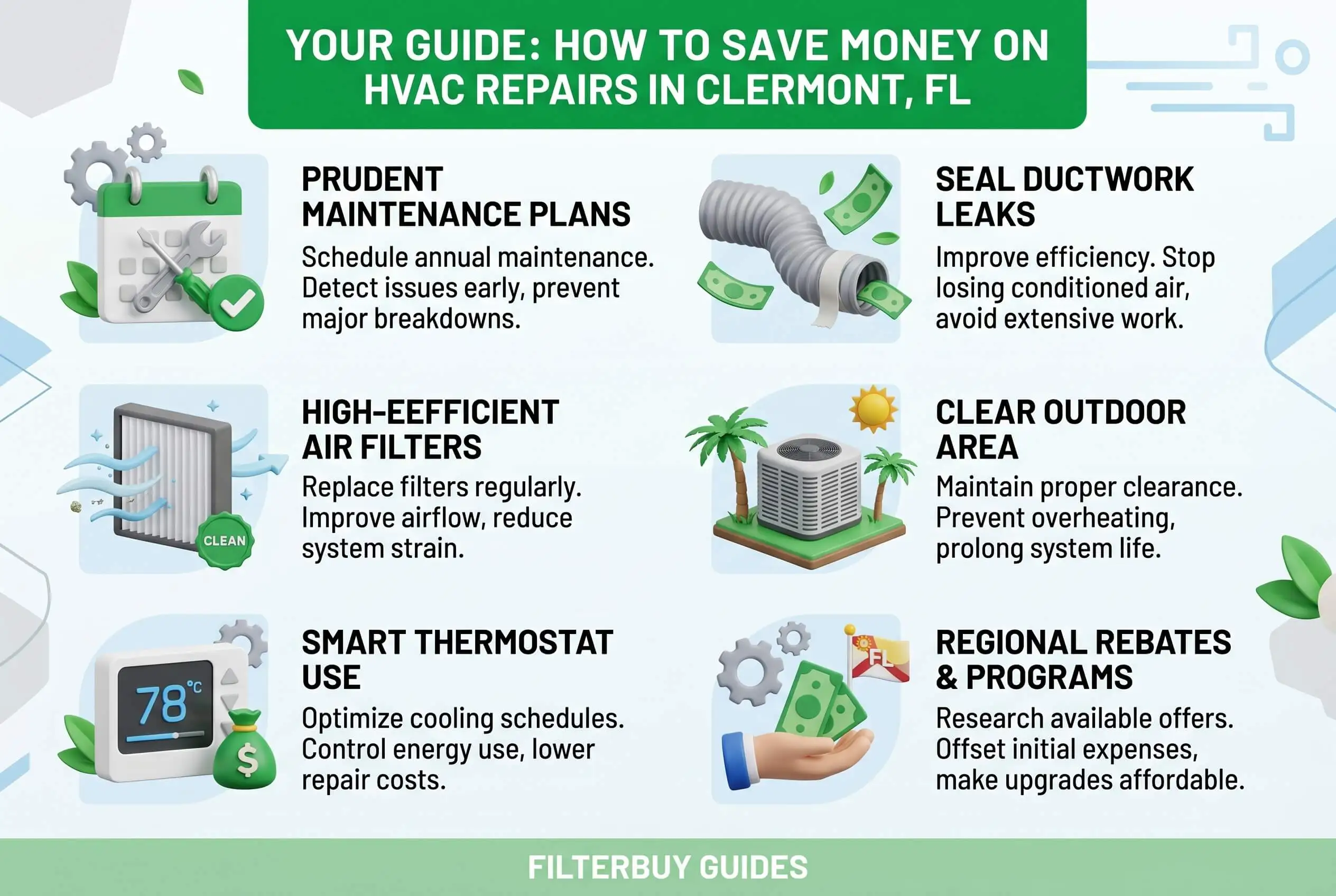
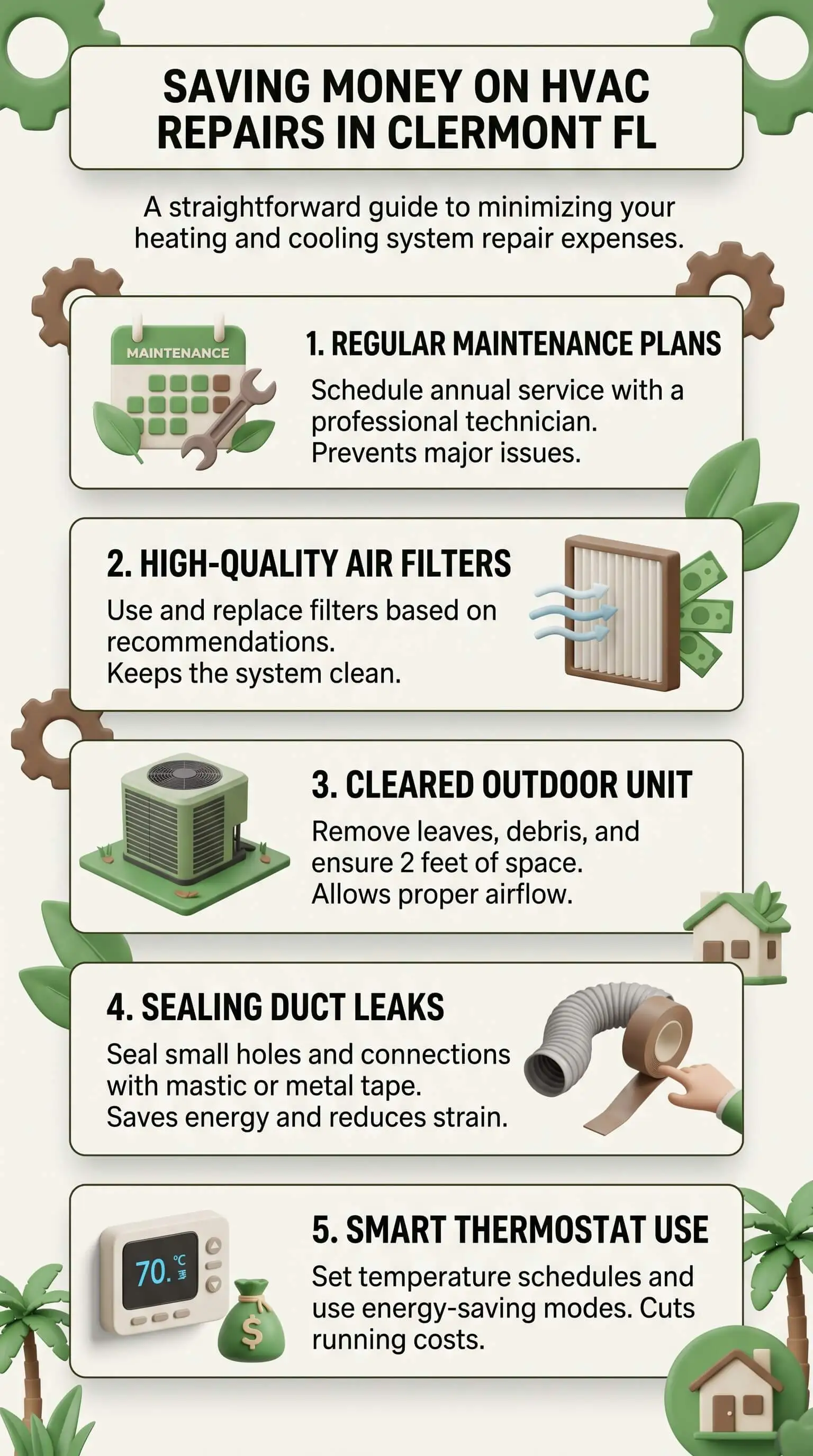
One of the easiest ways homeowners can reduce long-term repair costs is by improving airflow and keeping their HVAC system clean year-round. In How To Save Money on HVAC Repairs in Clermont FL, we explain how clogged filters, restricted airflow, and poor indoor air quality often force systems to work harder, increasing wear on expensive components during Florida’s extended cooling season. Replacing filters regularly with products like 16x22x1 dust defense air filters, 16x25x1 MERV 13 HVAC furnace filters, and pleated AC replacement filters can help improve airflow, support cleaner indoor air, and reduce the strain that often leads to avoidable HVAC repairs in Clermont homes.