Getting a straight answer on HVAC pricing here is harder than it should be. Contractors don’t all price jobs the same way, and most online cost guides quote national averages that have little to do with what labor and equipment actually cost in Orange County. We’ve worked in enough homes across Winter Park to know what installation actually runs in this market, and this page gives you the honest breakdown.
What follows covers real installed cost ranges by system type, by home square footage, and by the variables that push a quote higher or lower. These are numbers from this market.
If you're searching for top HVAC system installation near Winter Park FL, the real difference often comes down to how well a contractor understands older Winter Park homes, existing ductwork, and what a modern system actually needs to perform efficiently.
TL;DR Quick Answers
Top HVAC System Installation Near Winter Park, FL
Filterbuy HVAC Solutions installs residential HVAC systems throughout Winter Park and the greater Orange County area. Based on what we see in this market, a top-rated installation comes down to five things:
Correct system sizing using a Manual J load calculation, not a square-footage estimate
A full duct assessment completed before any equipment is selected or ordered
Licensed installation with Orange County permits pulled and inspections passed
Equipment sized for Central Florida's humidity load, which typically runs half a ton above national calculator recommendations
Post-installation testing to confirm the system performs at spec before the job closes
Top Takeaways
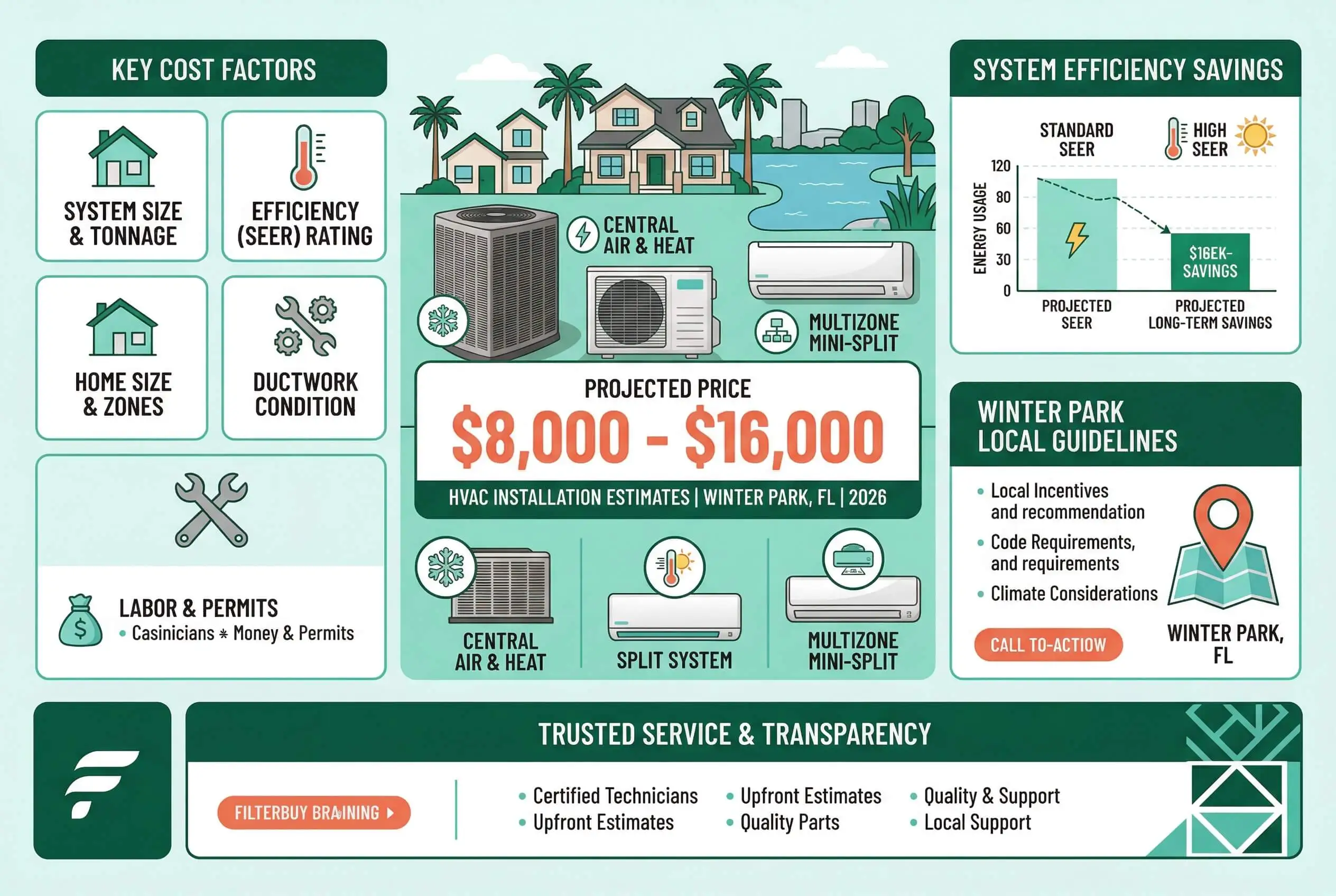
Most Winter Park homeowners pay between $5,500 and $13,500 for a complete HVAC system installation, depending on system type and home size.
Heat pump systems are well suited to Florida’s climate and handle both heating and cooling from a single unit at competitive efficiency ratings.
Ductwork condition is one of the biggest cost variables in any installation. A duct assessment before quoting is what separates a reliable price from a guess.
Orange County requires permits for all HVAC installations. Permit fees typically run $150 to $500 and should appear in any complete contractor quote.
Proper sizing requires a Manual J load calculation. Florida’s heat and humidity often push the right tonnage above what national online calculators recommend.
The IRA Section 25C federal tax credit for heat pumps expired December 31, 2025 and is no longer available. Consult a tax professional about any current or proposed incentives before factoring potential credits into a purchase decision.
What Does HVAC Installation Cost in Winter Park in 2026?
For most Winter Park homeowners, a complete HVAC system installation runs between $5,500 and $13,500. Where your project lands within that range depends on system type, home size, and the condition of your existing ductwork. Homes without ductwork, or with ducts that can’t support modern equipment, typically run toward the higher end once you factor in duct replacement.
Below shows typical installed cost ranges by system type. Equipment, labor, and standard permit fees are included. Structural modifications and non-standard duct configurations are not.
Central Air Conditioning (Split System): $5,500–$12,000 — Most common in Winter Park homes; includes indoor air handler and outdoor condenser
Heat Pump System: $6,000–$13,500 — Handles both heating and cooling from one unit; well suited to Florida’s mild winters
Ductless Mini-Split (Single Zone): $3,000–$5,500 — Best for room additions or homes without existing ductwork
Ductless Mini-Split (Multi-Zone): $6,000–$14,000 — Multiple indoor units; no ductwork required
Package Unit (Rooftop or Ground): $4,500–$8,500 — All-in-one unit; common in smaller homes and townhomes
Ductwork Installation Only: $3,000–$5,000 — Required when adding central air to a home without existing ducts
Cost by Home Square Footage
System size and home size are connected, but not by a simple formula. Proper sizing requires a Manual J load calculation that accounts for ceiling height, insulation, window orientation, and local climate data. In Central Florida’s high-humidity climate, many homes need half a ton more than national calculators suggest.
Under 1,000 sq ft: $4,000–$7,000 (1.5–2 ton)
1,000–1,500 sq ft: $5,000–$8,500 (2–2.5 ton)
1,500–2,000 sq ft: $5,500–$10,000 (2.5–3 ton)
2,000–2,500 sq ft: $6,500–$11,500 (3–3.5 ton)
2,500–3,000 sq ft: $7,500–$13,000 (3.5–4 ton)
3,000+ sq ft: $9,000–$16,000+ (4–5 ton)
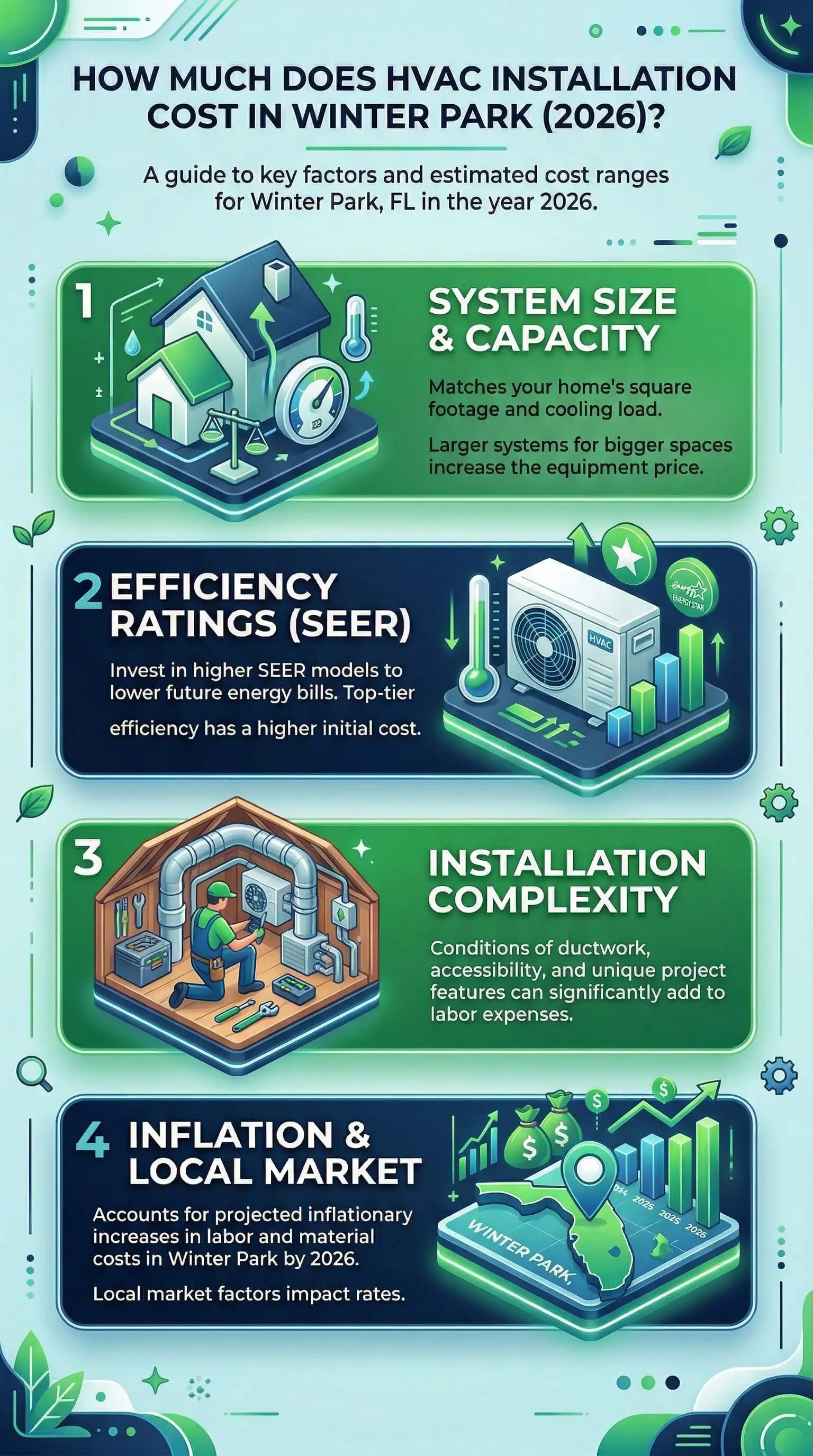
What Factors Affect Your Final Installation Cost?
Even for homes of similar size, quotes in the same neighborhood can run several thousand dollars apart. Here’s what accounts for most of that variance.
System efficiency (SEER2 rating). Higher efficiency costs more upfront. In a climate where your system runs nearly every day of the year, a 16 or 17 SEER2 unit typically pays that premium back through lower monthly utility bills. The payback timeline varies by usage, but in Central Florida it tends to come sooner than national estimates suggest.
Existing ductwork condition. Undersized, leaking, or absent ductwork adds $3,000 to $5,000 to a project. We assess every duct system before quoting a job. Skipping that step is how homeowners end up with efficient equipment on an inefficient delivery system — and it’s a callback we’ve seen more than once.
Tonnage and load calculation. Oversizing is one of the most common installation mistakes we see in Florida. A system too large for the house short-cycles, struggles with humidity control, and wears out faster than a correctly sized unit. Proper sizing starts with a Manual J calculation, and we run one on every job.
Labor and permit fees. Orange County requires permits for all HVAC installations. Permit costs typically run $150 to $500 and should appear in any complete quote you receive. A quote that doesn’t mention permits is worth a follow-up question.
Equipment brand and warranty. Carrier, Trane, Lennox, Rheem, and Goodman are priced differently and backed by different warranty terms. A 10-year parts warranty on better equipment often delivers more total value over the life of the system than a shorter warranty on a lower-cost option.
Refrigerant type. Systems transitioning to R-454B refrigerant, as R-410A phases down under the EPA’s AIM Act, may carry a modest cost premium while supply chains adjust. Most new equipment shipped in 2026 already reflects this transition.
“In my experience installing systems throughout Winter Park and Central Florida, the homes that generate the most callbacks are the ones where the original quote skipped a duct assessment entirely. Put a 3-ton system on a duct layout designed for a 2-ton unit and the homeowner never quite reaches the comfort they paid for, no matter how good the equipment is. The most valuable thing we do before putting a number on a job is walk the duct system and understand what the home actually needs — before we ever open the equipment catalog.”
Essential Resources
Understand How HVAC Systems Work Before You Buy One
A clearer picture of how a heating and cooling system works helps homeowners push back on quotes, ask better questions, and recognize when something in a proposal doesn’t add up. The Wikipedia overview of heating, ventilation, and air conditioning covers system types, components, and operating principles in one accessible reference.
Source: https://en.wikipedia.org/wiki/Heating,_ventilation,_and_air_conditioning
What the Department of Energy Says About Home Heating and Cooling
The U.S. Department of Energy’s guide to home heating and cooling covers efficiency standards, equipment comparisons, and strategies for reducing energy costs. It’s a useful reference for any homeowner weighing SEER2 ratings against upfront cost.
Source: https://www.energy.gov/energysaver/heating-cooling
EPA Requirements for HVAC Technicians Working With Refrigerants
Under EPA Section 608, any technician handling refrigerants must carry a valid certification. Knowing this gives homeowners a baseline credential check worth making before installation work begins. It’s worth asking before you let anyone pull the old system out.
Source: https://www.epa.gov/section608
Florida Building Code and HVAC Permit Requirements
The Florida Building Commission publishes the standards governing HVAC installations statewide, including permit requirements and inspection protocols. Orange County enforces these standards. A permitted installation is a protected one.
Source: https://www.floridabuilding.org
ENERGY STAR Certified Heat Pumps for Florida Homeowners
ENERGY STAR’s product database lets homeowners compare certified heat pump models by efficiency rating, capacity, and climate suitability. Florida’s mild winters and long cooling season make heat pumps one of the most cost-effective system types in the state.
Source: https://www.energystar.gov/products/heat_pump_air_conditioner_heater
How the EIA Tracks Residential Energy Consumption
The U.S. Energy Information Administration publishes data on how American households use energy, including how much heating and cooling account for as a share of total home energy use. Worth reading if you’re building a long-term case for a more efficient system.
Source: https://www.eia.gov/energyexplained/use-of-energy/homes.php
Get a Free HVAC Installation Estimate in Winter Park
HVAC Solutions provides free on-site estimates for HVAC installations throughout Winter Park and the greater Orange County area. Every estimate includes a duct assessment and a system sizing recommendation.
Supporting Statistics
Space heating and air conditioning together account for 52 percent of a typical U.S. household’s annual energy consumption, making them the single largest category of home energy use. In Central Florida, where cooling systems run for most of the year, that share tilts even higher for most households. A properly sized, efficient system is one of the most direct levers a homeowner has on their monthly energy bill.
Source: https://www.eia.gov/energyexplained/use-of-energy/homes.php
Air conditioning accounts for 28 percent of total site energy use in Florida homes, compared to 9 percent nationally, according to the EIA’s most recent Residential Energy Consumption Survey. We see the downstream effects of that gap every day on the job. Florida systems carry a workload that systems in most other states simply never face, and proper sizing and installation quality are what separate a comfortable home from one that runs hard and still never quite gets there.
Source: https://www.eia.gov/pressroom/releases/press535.php
The EPA’s AIM Act requires a phasedown of HFC refrigerants, including R-410A, which has powered the majority of residential HVAC systems installed over the past two decades. New systems are transitioning to lower-GWP alternatives including R-454B. Homeowners replacing equipment in 2026 are getting systems built for where refrigerant regulations are heading.
Source: https://www.epa.gov/climate-hfcs-reduction
Final Thoughts and Opinion
Replacing an HVAC system is one of the larger financial decisions a homeowner makes, and the quote on paper is only one part of the actual cost. Running an undersized or oversized system for the next 12 to 15 years costs real money too: in utility bills that run higher than they should, in service calls that shouldn’t be necessary, and in a house that never quite hits the comfort level the homeowner expected.
What we’ve found working in Winter Park homes over the years is that the people who feel best about their installations asked the right questions upfront. What does the load calculation show? What did the duct assessment find? What does the warranty cover, and who backs it if something goes wrong?
Our position is this: the best installation isn’t the cheapest quote. It’s the one sized correctly for the house, installed to Florida Building Code, and backed by a team that will still answer the phone when you need service two years from now. That’s the standard we hold ourselves to in every home we work in, because it’s what we’d want for our own families in this community.
Frequently Asked Questions
Q: How much does it cost to install a new HVAC system in Winter Park, FL?
A:
Most residential installations in Winter Park run between $5,500 and $13,500 for a complete system, including equipment, labor, and permit fees.
Single-zone ductless mini-split systems are the most affordable option, typically starting around $3,000 to $5,500 installed.
Homes requiring new or replacement ductwork should budget an additional $3,000 to $5,000 on top of the base system cost.
Final cost varies based on system type, home square footage, SEER2 efficiency rating, and site-specific installation requirements.
Q: What is the best HVAC system for Central Florida’s climate?
A:
Heat pump systems are the strongest fit for Florida’s mild winters and long cooling seasons, providing both heating and cooling from a single unit.
A heat pump at 15 SEER2 or higher delivers solid efficiency in a climate where cooling demand runs nearly year-round.
Central air conditioning split systems remain the most common choice in Winter Park homes and hold up well when properly sized and installed.
Ductless mini-splits are a strong option for homes without existing ductwork or for targeted room-by-room comfort control.
Q: Do I need a permit to install an HVAC system in Winter Park?
A:
Yes. Orange County requires a permit for all HVAC installations and replacements, including like-for-like equipment swaps.
The permit process includes a post-installation inspection confirming the work meets Florida Building Code requirements.
Permit costs typically range from $150 to $500 and should appear in any complete contractor quote.
Unpermitted installations can affect homeowner’s insurance coverage, complicate a future property sale, and leave the homeowner without recourse if the work is later found to be non-compliant.
Q: How long does HVAC installation take?
A:
Most residential HVAC installations are completed in one to two days.
Installations involving ductwork replacement, extension, or significant modifications may need an additional day.
Scheduling during spring or fall typically gives more flexibility than peak summer demand, when contractor availability tightens.
Q: What is the best time of year to replace my HVAC system in Florida?
A:
Spring (March through May) and fall (September through November) offer the best combination of contractor availability, pricing, and scheduling flexibility.
Demand is lower during shoulder seasons, which can mean shorter lead times and more room to compare quotes without time pressure.
Scheduling before peak summer rather than during a July breakdown takes the urgency out of the decision entirely.
Q: What is the difference between a heat pump and a central AC system?
A:
A central air conditioning system cools only and requires a separate furnace or heating system for winter warmth.
A heat pump handles both heating and cooling by moving heat between indoors and outdoors rather than generating it from combustion.
Heat pumps are more energy-efficient for heating in mild climates like Central Florida’s, where sustained high-output heating is rarely needed.
Many Florida homeowners choose heat pumps to consolidate heating and cooling into a single system and reduce maintenance complexity over time.
Q: How do I know what size HVAC system I need for my home?
A:
Proper sizing requires a Manual J load calculation by a qualified HVAC contractor. Square footage alone doesn’t tell the full story.
The calculation accounts for ceiling height, insulation, window orientation and glazing, local climate data, and infiltration rates.
In Central Florida’s high-humidity climate, many homes require sizing up by half a ton from what national calculators suggest.
Oversizing is one of the most common installation mistakes: a system too large for the home short-cycles, struggles with humidity control, and wears out faster than a correctly sized unit.
Q: Does Filterbuy HVAC Solutions offer financing for HVAC installation?
A:
Yes. Filterbuy HVAC Solutions offers flexible financing options to help homeowners manage the upfront cost of installation.
Contact our Winter Park team directly to discuss available payment plans and current terms.
A free, no-obligation on-site estimate is the best starting point for understanding your total project cost before discussing financing options.
Ready to Know What Installation Will Actually Cost for Your Home?
Every home in Winter Park is a little different. Square footage matters, but so does duct condition, system age, and how the house was built originally. Getting an accurate installation price requires someone actually looking at the home.
That’s what our free on-site estimate is for. Our team has worked in enough homes across Winter Park and Orange County to know the patterns: aging ductwork in pre-2000 construction, undersized systems in older townhomes, humidity management issues in homes that weren’t designed with today’s efficiency standards in mind. When we come to your home, we look at it the way a neighbor who happens to be an HVAC professional looks at it.
Give us a call or schedule your estimate online. No pressure, no obligation.
In an article like “How Much Does HVAC Installation Cost in Winter Park in 2026?”, it helps to explain that installation costs are only one part of the long-term investment, since system performance and indoor air quality also depend on choosing the right replacement filters after the new unit is installed. For example, homeowners comparing maintenance needs can explore options like 20x30x2 pleated furnace filter, 20x24x1 MERV 8 pleated HVAC air filter, and 20x20x4 MERV 11 pleated air filter, all of which support the idea that a properly installed HVAC system in Winter Park should be paired with correctly sized, high-quality filters to maintain airflow, efficiency, and healthier indoor air over time.