Ninety-four degrees outside. A hundred and eighteen inside, door shut, two box fans running flat out. I clipped a probe thermometer to that workbench last August because the homeowner was sure the fans were helping. They weren’t. Fans stir air around a room, but they can’t carry heat out of it, and that one distinction sits underneath almost everything people get wrong about cooling a garage. A garage air conditioner is built to remove heat rather than simply move hot air around. Heat is invisible, which makes it very easy to believe you’re winning when all you’re doing is moving hot air in a circle.
TL;DR Quick Answers
Garage Air Conditioner
A garage air conditioner pulls heat out of the space and dumps it outside through a refrigerant loop. Garages need more capacity than rooms of the same size, because uninsulated doors, air leaks, attic heat and parked vehicles all add load that a standard sizing chart ignores.
Best fit for most garages: a ductless mini split, which needs no window and no ductwork.
Typical sizing: 9,000 to 12,000 BTU for a one-car bay, 12,000 to 18,000 BTU for two cars.
Check the power first: anything above 12,000 BTU usually wants 230 volts on a dedicated circuit.
Skip the single-hose portable: it pulls hot outside air back in through every gap in the envelope.
Safety note: a recirculating unit brings in no fresh air, so exhaust and fuel vapor stay put.
Top Takeaways
An air conditioner relocates heat rather than producing cold, so where you put the outdoor unit matters as much as how big it is.
Garages carry four loads a same-size room doesn’t: radiant gain through the door, infiltration around the seal, heat from the attic above, and soak from a recently parked vehicle.
Correct the standard capacity range upward for an uninsulated door, tall ceilings and western exposure, but don’t jump two sizes.
Oversizing costs you humidity control. A short-cycling unit leaves the room cool, damp and quietly rusting your tools.
Anything above roughly 12,000 BTU generally wants 230 volts on a dedicated circuit, so price the electrician before you price the equipment.
Garage air fouls filters two to three times faster than living-space air, so shorten your maintenance interval to match.
Cold Isn’t Something a Machine Can Make
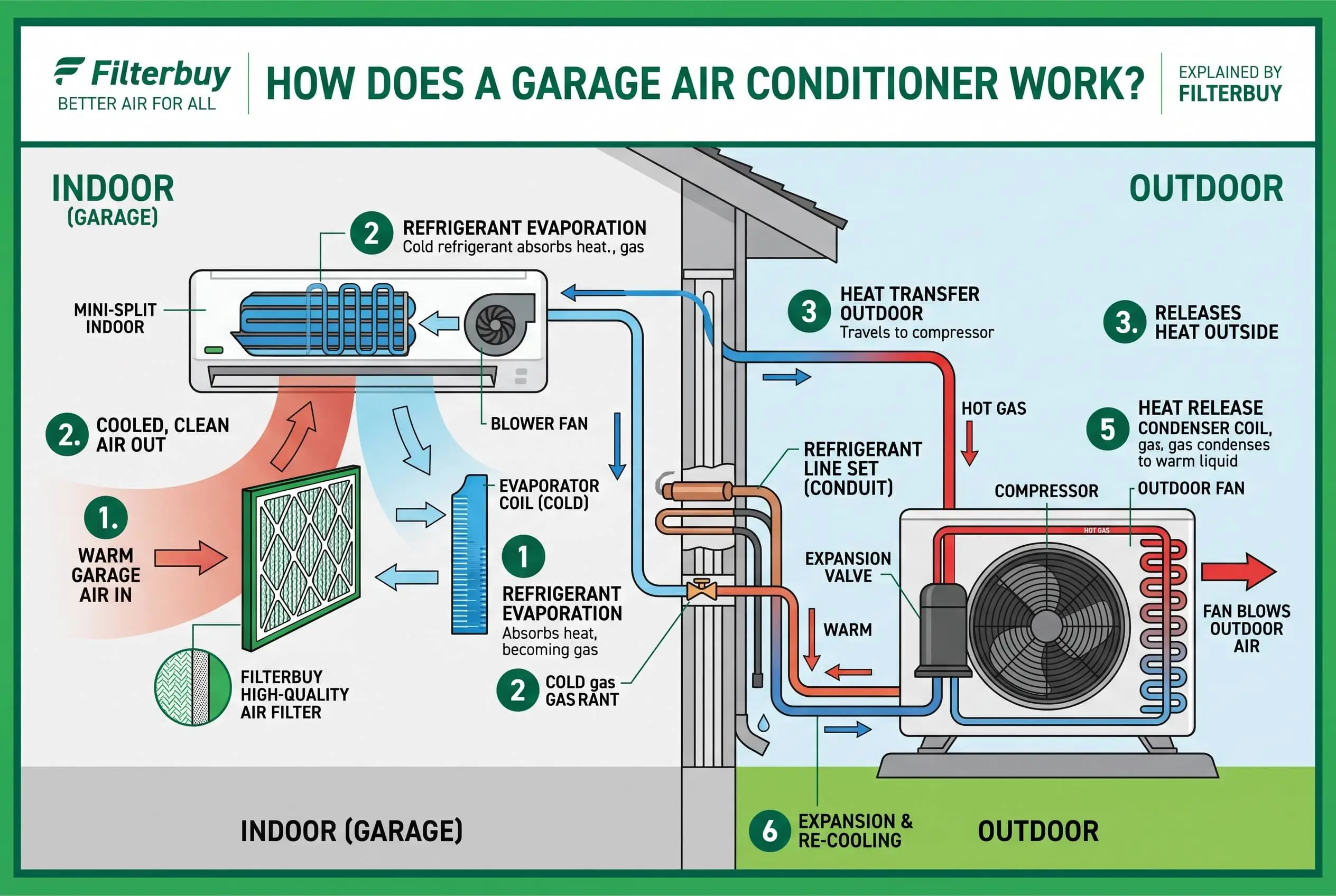
Cold isn’t a substance. It’s the absence of heat, and the only way to get more of it is to physically pick heat up and set it down somewhere else. Your garage air conditioner does that with a sealed loop of refrigerant, and once you can picture the loop, the rest of this stops being mysterious.
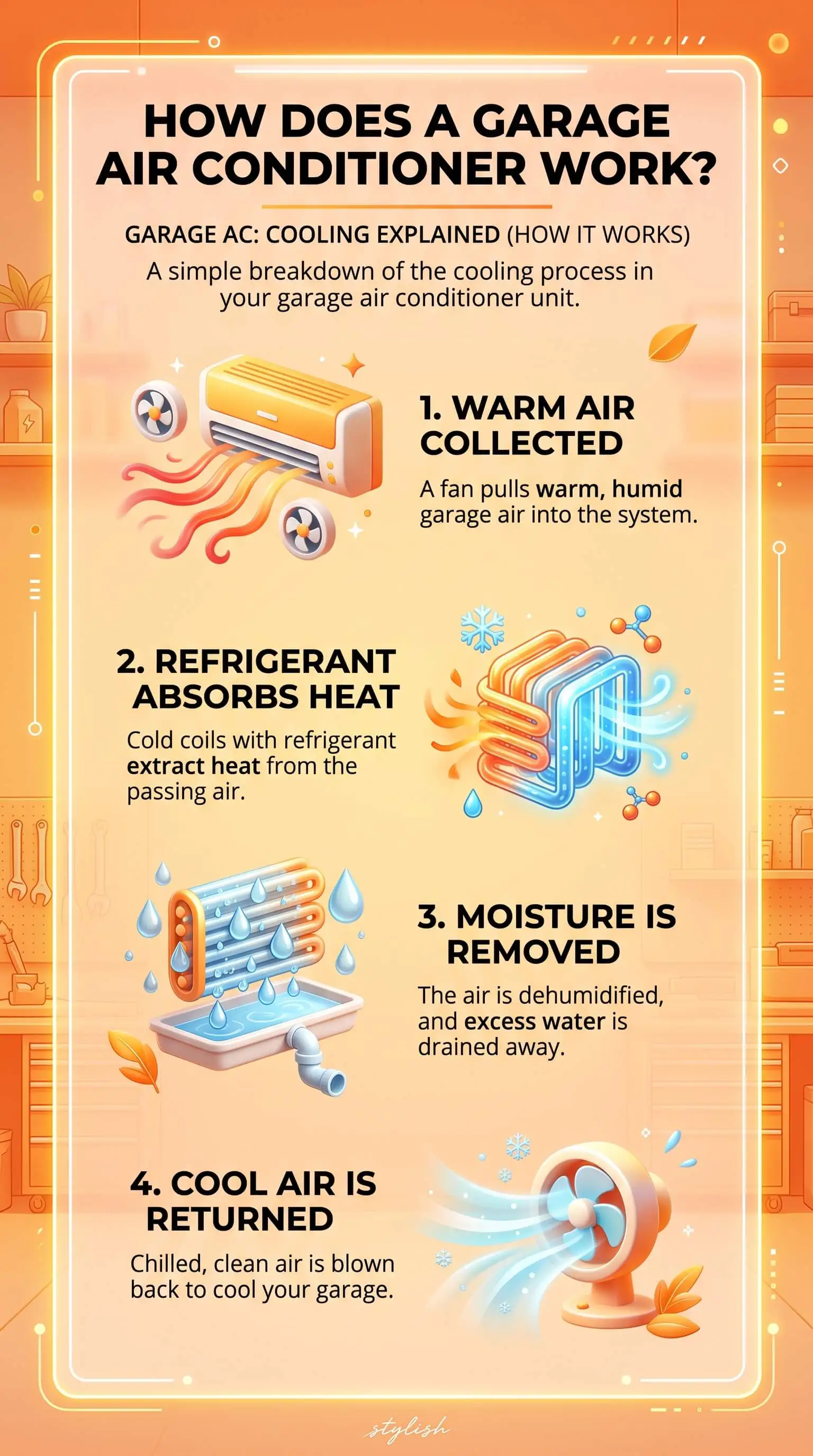
Refrigerant arrives at the indoor coil as a cold, low-pressure liquid. A fan drags garage air across that coil, the refrigerant soaks up the heat and boils into a gas, and the air coming off the far side is cooler and drier than it went in. The compressor then squeezes that gas until it’s hotter than the air outdoors, the outdoor coil sheds the load, and the refrigerant condenses back to liquid to go around again. The vapor-compression cycle running that loop has barely changed in a hundred years.
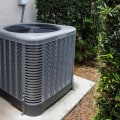
People skip the consequences. Every bit of heat you pull out of that garage has to land somewhere outside, so wedging the outdoor unit into a dead-air pocket between a fence and an overgrown hedge handicaps the machine before it ever runs.
Why a Garage Fights Back Harder Than a Bedroom the Same Size
Four heat loads show up in a garage that a bedroom never deals with. Miss them and your sizing math is wrong before you start.
Radiant gain through the door. An uninsulated steel door facing west drinks sun all afternoon and keeps radiating it inward long after sunset. Occupational heat guidance treats radiant heat as its own environmental factor, separate from air temperature, and for good reason.
Infiltration around the seal. A worn bottom seal and unsealed side jambs on a sixteen-foot door leak more air than any bedroom window ever will.
Heat pressing down from overhead. Most garage ceilings sit directly under an unconditioned attic with little or no insulation between the two.
Vehicle heat soak. Park after a twenty-minute drive and the engine block, exhaust and rotors keep unloading heat into the room for an hour or more. I’ve watched a bay climb four degrees with the AC already running, purely because a truck had just pulled in.
Four Ways People Cool a Garage, and What Each One Really Buys You
Portable Units
A single-hose portable is the weakest thing on the shelf. It dumps conditioned indoor air out through the window duct, which drops the room into negative pressure and pulls hot outside air straight back in through every gap in the envelope. In a leaky garage, that’s a fight you can’t win. Dual-hose models sidestep the worst of it. Either way you surrender floor space and gain noise.
Window Units
Cheap, effective in a small bay, and dependent on having a window you’re willing to give up. Installation quality decides the whole outcome here. Skip the insulation panels that came in the box and the unit leaks about as much air as a six-square-inch hole in your wall, which in a garage means you’re paying to cool the driveway.
Through-the-Wall Units
A sleeved wall unit solves the no-window problem and seals far better than a window install, because it sits in a properly framed opening. It costs more up front and it commits you to a hole in the wall. For a shop that’s going to stay a shop, I think it’s badly underrated.
Ductless Mini Splits
For most garages, this is the one. No ductwork, no window, a quiet indoor head, an inverter compressor that modulates instead of slamming on and off, and heat in winter out of the same box. The trade-off is real, though. It costs the most, and you’ll need a licensed installer to run the line set and pull a proper vacuum on it. For garages tied into an existing central system, updating your ductwork may be part of the cooling plan. For a fuller look at how the options stack up on cost, comfort and effort, this breakdown of garage cooling setups walks through it.
Sizing It Right, in Both Directions
Standard capacity charts assume an insulated room with an eight-foot ceiling. Your garage is neither of those things. Start from the published range for your floor area, then correct upward for an uninsulated door, tall ceilings, western exposure and regular vehicle use.
One-car bay, roughly 200 to 300 square feet: 9,000 to 12,000 BTU
Two-car bay, roughly 400 to 600 square feet: 12,000 to 18,000 BTU
Three-car bay or high ceilings, 600 square feet and up: 18,000 to 24,000 BTU and beyond
Now resist the urge to jump two sizes for insurance. An oversized unit satisfies the thermostat on temperature long before it’s run enough minutes to pull moisture out of the air, so it short cycles and hands you a room that’s cool and clammy. In a humid climate you’ll see the result inside a single season, as surface rust creeping across hand tools and table saw beds. I’d take a slightly undersized inverter unit running long and steady over an oversized one hammering itself on and off every four minutes.
Power, Placement, and the One Thing Nobody Prints on a Spec Sheet
Open the panel before you open your wallet. Most garages run off a shared 20-amp branch that’s already feeding the door opener, the lights and every outlet on the wall. A 12,000 BTU unit will usually live happily on 115 volts. Go bigger and you’re generally into 230 volts on a dedicated circuit, and that electrician visit belongs in your budget on day one rather than showing up as a surprise on install day.
Two more things before the head goes on the wall. Condensate has to drain somewhere, and gravity won’t cooperate with wishful thinking, so give the line a continuous fall to daylight or add a pump. Then respect the clearance the manufacturer specifies around the outdoor unit, because letting a condenser breathe its own discharge air is the quickest way to throw away capacity you already paid for.
Here’s the part that matters most. A recirculating indoor unit brings in no fresh air at all. It cools what’s already in the room and nothing else, which means engine exhaust and fuel vapor stay exactly where they are in an attached garage. Carbon monoxide gives you no warning, no color and no smell. Never run an engine or a generator in there with the door down, whatever the air conditioner happens to be doing, and get the wall you share with the house properly air sealed so nothing migrates into the living space.
A Dirty Room Needs a Different Maintenance Schedule
Garage air carries sawdust, tire particulate, grinding swarf and whatever blows in off the driveway. A mini split filter that would coast three months in a living room can load up in four to six weeks in a working shop, which is why high quality filters matter in spaces with heavier airborne debris. Pull and rinse the mesh filters monthly through the season, and plan on a real coil cleaning every year instead of every few. A fouled evaporator loses capacity quietly. By the time you notice the room isn’t getting cold, that compressor has been straining for months.
"Most of the time the equipment isn’t the problem. It’s the load nobody counted. Folks size for floor area and forget that the garage door is a west-facing radiator and the truck they just parked is still giving off heat. A top-rated HVAC installer should account for those hidden loads before recommending equipment. I shoot the door with an infrared gun before I quote anything, because if that steel reads 140 degrees, the whole sizing conversation changes."
7 Essential Resources
1. Get the Sizing Right the First Time
Federal capacity guidance hands you a defensible starting number, plus the adjustment factors for sun exposure and ceiling height that most retail charts quietly leave out. It also explains, in plain terms, why bigger isn’t better. ENERGY STAR: Room Air Conditioners
2. See What’s Actually in the Air You’re Recirculating
Automobile exhaust from attached garages is named outright as an indoor carbon monoxide source. Read it before you assume an air conditioner improves anything about the air in that room. EPA: Carbon Monoxide and Indoor Air Quality
3. Learn the Exposure Numbers, Not Just the Warnings
Real concentration thresholds, how symptoms progress, and where alarms belong. It also states flatly that you should never leave a car running in an attached garage, even with the door open. CPSC: Carbon Monoxide Fact Sheet
4. Work Out Whether Your Garage Is Unsafe or Just Miserable
Occupational heat guidance pulls apart air temperature, humidity, radiant heat and air movement, then gives you workload thresholds for each. If you actually work in that space, this reframes the question entirely. OSHA: Heat Hazard Recognition
5. Check Your Circuit Before You Check Prices
Home electrical safety fundamentals, including what overloaded branch circuits do and why a large appliance deserves its own run instead of sharing with the door opener. NFPA: Electrical Home Fire Safety
6. Confirm the Efficiency Rating on the Box Is Real
An independent certified performance directory lets you verify a manufacturer’s published ratings instead of taking the marketing copy at its word. AHRI Directory of Certified Product Performance
7. Seal the Shared Wall Before You Spend a Dollar on Cooling
Detailed federal guidance on air sealing an attached garage, right down to the joist bay and rim joist details that decide whether your cooled air stays put and whether garage fumes reach the house. Building America Solution Center: Air Sealing Attached Garage
Sizing, air sealing, electrical safety, carbon monoxide awareness, and verified efficiency ratings all matter when cooling a garage, and heat pumps can be a strong option when you want efficient cooling in summer plus heating from the same system in winter.
Supporting Statistics
Air conditioning ate about 19 percent of all electricity used in US homes in the most recent national survey year, roughly 254 billion kilowatt-hours. Adding a garage adds to that line. US Energy Information Administration
Heat kills more Americans each year than floods, lightning, tornadoes and hurricanes combined. The ten-year average the National Weather Service cites is 123 deaths annually. National Weather Service
In an average year, heat drives 67,512 emergency department visits, 9,235 hospitalizations and 702 deaths nationwide. An unconditioned garage in July isn’t a trivial place to spend an afternoon. CDC Heat and Health Tracker
Cooling a garage can add to household energy use, but it can also make hot-weather work safer and more comfortable, with pleated furnace filters helping support cleaner airflow when the garage is connected to a filtered HVAC system.
Final Thoughts and Opinion
If I were spending my own money on one garage, I’d insulate the door first and buy the air conditioner second. I’ve watched people drop a 24,000 BTU unit into an uninsulated bay and stay disappointed, then add a 200 dollar door insulation kit and finally get the room they wanted out of a unit half that size. Your envelope decides how hard the machine has to work, and the envelope is almost always the cheaper fix.
Where I’ll break with the standard advice: I don’t think a portable unit is a reasonable starting point for anybody. It gets sold as the low-commitment choice and it performs like an expensive fan in most garages. If the budget genuinely won’t stretch to a mini split this year, a properly installed window or through-wall unit with professional AC installation in a sealed opening will beat a portable at a similar price and keep beating it for a decade.
Frequently Asked Questions
Can you put an air conditioner in a garage without a window?
Yes. A ductless mini split needs only a three-inch penetration for the line set and drain, and a through-the-wall unit needs a framed sleeve. Neither one asks for a window. A portable is the only common option that genuinely has to vent through an opening, which is worth knowing before you buy one thinking it’s the flexible choice.
What size air conditioner do I need for a two-car garage?
Plan on 12,000 to 18,000 BTU for a typical 400 to 600 square foot two-car bay. Push toward the top of that range if the door is uninsulated, the ceiling runs above nine feet, or the door faces west. Drop toward the bottom if the space is insulated and shaded.
Will a garage air conditioner lower my humidity?
It will, as long as it’s sized correctly and runs long cycles. Moisture comes off on the coil over time, so a unit that satisfies the thermostat in four minutes barely dehumidifies at all. Inverter-driven mini splits handle this better than fixed-speed equipment because they keep running at reduced output instead of shutting off.
Is it safe to run an air conditioner in an attached garage?
The unit itself is safe. What isn’t safe is assuming it ventilates the space. A recirculating indoor head introduces no outside air whatsoever, so engine exhaust and fuel vapor build up exactly as they would without it. Never run an engine or a generator inside with the door down, and keep a carbon monoxide alarm in the adjoining living space.
Do I need to insulate the garage before installing AC?
You don’t have to. You will regret skipping it. Insulating the door and sealing the perimeter usually lets you drop a full capacity tier and cuts the runtime of whatever unit you install. MERV 8 pleated HVAC furnace air filters can support cleaner airflow when the garage is served by a compatible filtered HVAC system. Dollar for dollar, it’s the highest-return move in the entire project.
How often should I clean the filter on a garage unit?
Monthly through the cooling season if you do woodworking, grinding or anything else that throws dust into the air. Every two months in a garage used mainly for parking. Add a full coil cleaning once a year on top of that.
Cooling a Garage Starts With Knowing What the Machine Is Really Doing
Once you can see that the unit is relocating heat instead of manufacturing cold, the sizing, the placement and the insulation all stop being guesswork. Work out your real load first, then pick the best air conditioner for a garage that can carry it.