Two thermostats on the wall almost always mean two air filters in the house, and the second one is the filter people forget. It sits in an attic air handler, a garage furnace or a ceiling grille at the top of the stairs, packing up with dust while the hallway filter gets all the attention.
You're already the one who keeps this house running, so let's make the invisible part visible. Air filter replacement in a two-system home is easy once you know where both filters live. I'll walk you through mapping each one and setting a schedule that keeps either unit from slipping.
TL;DR Quick Answers
air filter replacement
Air filter replacement takes about five minutes. Turn the system off, slide out the old filter, and insert a new one of the same size with the arrow pointing toward the blower. Check it monthly and replace it every one to three months. Homes with two HVAC systems need this routine for each unit.
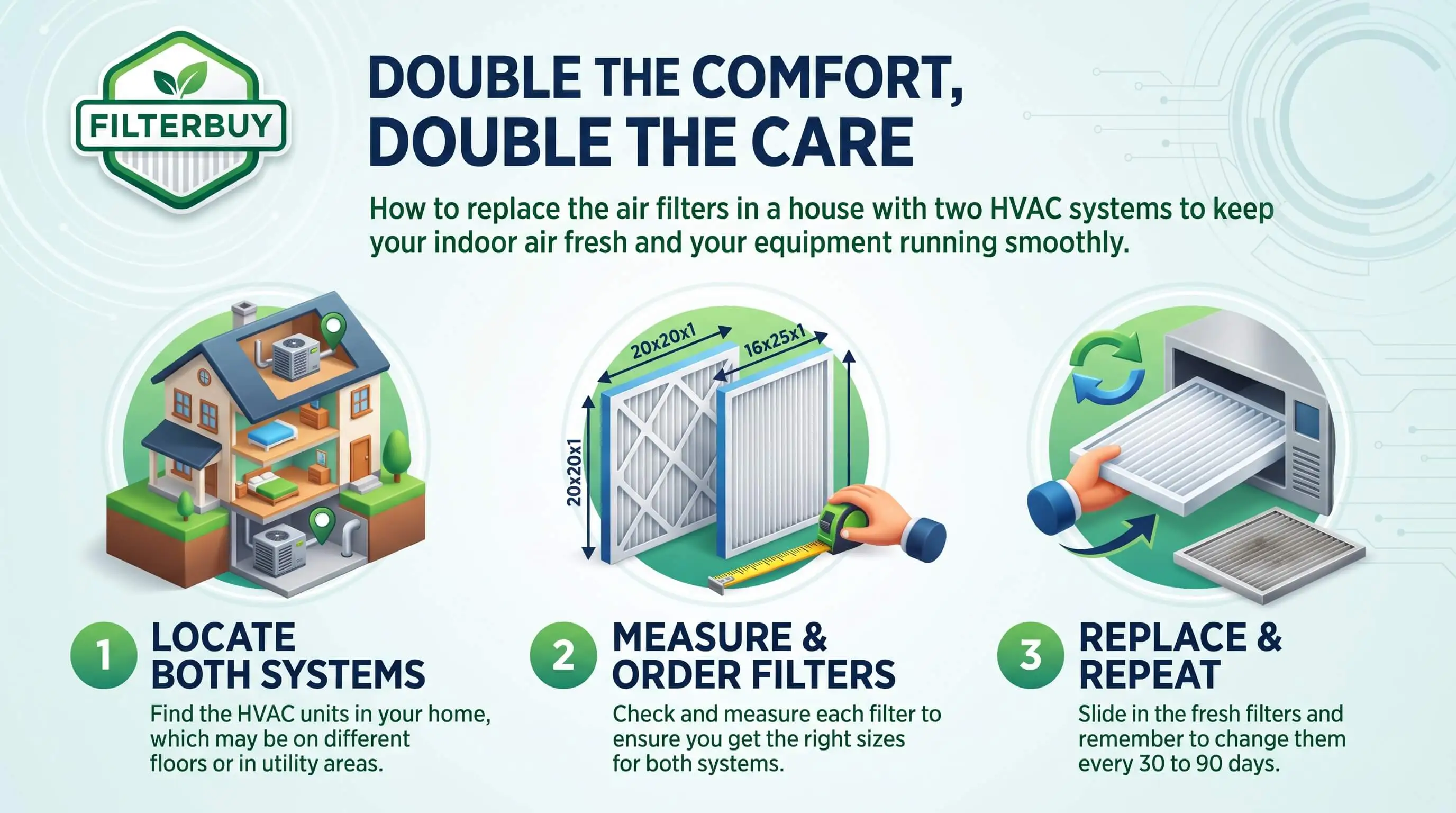
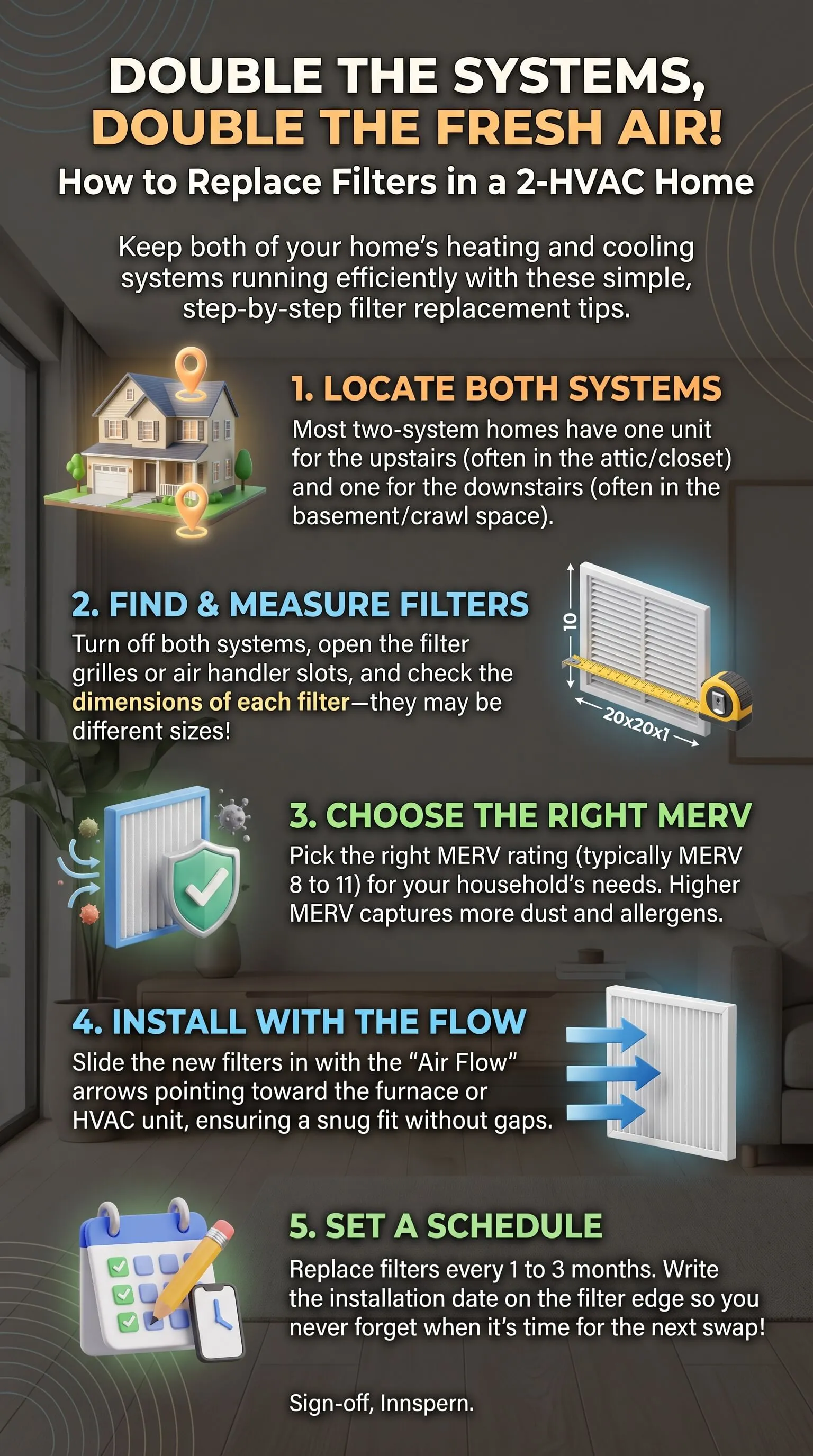
Locate each filter: look at return grilles, attic air handlers and furnace slots.
Match the size: read the printed size on the old frame and confirm it with a tape measure.
Choose a sensible MERV: MERV 8 to 13 fits most homes if the blower can handle it.
Date the frame: write the install date so you know when the next change is due.
Track both units: the system that runs longest fills its filter first, usually upstairs in summer.
Stock a spare: keep one replacement per size so the next swap is quick.
Top Takeaways
Two systems, two filters: each air handler or furnace has its own, often in a different spot.
Sizes often differ: measure both, and record the printed and actual dimensions.
Filters fill unevenly: the unit that runs longest loads fastest, usually upstairs in summer.
One schedule, two checks: share a replacement date, but look at each filter monthly.
Match MERV to the blower: MERV 8 to 13 suits most homes when the equipment allows it.
Why Two HVAC Systems Mean Two Filter Routines
Every air handler or furnace pulls return air through its own filter before the blower sends it back into your rooms. That air filter catches the dust, pollen and pet dander you can't see before any of it reaches the blower and coil. So two systems give you two filters, each working on its own clock.
Where the Filters Usually Hide
Wall or ceiling return grilles in hallways and on upstairs landings
Attic air handlers, which often serve the second floor
Garage, basement or closet furnaces serving the first floor
A second return grille on the same system, which some homes have
Build a Filter Map Before You Buy
If I could hand you one tool, it would be a filter map. That's a short note for each system that you check before every order. Write down:
Where the filter slot or grille sits
The size printed on the frame and the size you measure
The MERV rating you have installed now
Which way the airflow arrow points
The date you last changed it
Printed sizes are nominal, so a filter labeled 20x25x1 usually measures a little smaller. Measure the old filter or the slot, then match the printed size. Jot the size and date on the slot cover too. It saves you a second climb into the attic. For more on sizing, see why standard filter sizes matter.
Step-by-Step Air Filter Replacement for Both Systems
Turn off both systems at their thermostats.
Open the first filter slot or return grille.
Note the size and which way the airflow arrow points.
Slide the old filter out and take a look at it.
Wipe out any dust or debris, and check the slot for gaps.
Insert the new filter with the arrow pointing toward the blower.
Close the panel or grille so it seals snugly.
Write today's date on the frame or your filter map.
Repeat every step on the second system.
Turn both systems back on and feel for airflow at a few vents.
How Often to Change Filters in Each System
Most 1-inch pleated filters need changing every one to three months, with a quick look once a month. In a two-system home, the two filters almost never fill at the same pace. I break down intervals in more detail in how often to change an HVAC air filter.
Why One Unit Works Harder
Heat rises and attics bake, so an upstairs or attic unit usually runs longer all summer. In winter the downstairs unit may take over as the hard worker. Whichever one runs more pulls more air through its filter and fills it faster.
Pets, Allergies and Seasonal Use
Heavy-shedding pets shorten filter life
Allergies or asthma in the house call for more frequent checks
Peak summer and winter months load filters faster
Nearby construction or wildfire smoke can clog a filter in a few weeks
Should You Change Both at the Same Time?
I'd say yes, with one exception. Keep one shared replacement date so neither filter gets forgotten. Then check both every month and swap out whichever one fills first, even if it's early.
Common Mistakes in Two-System Homes
Assuming both units take the same size
Forgetting a second return grille on one system
Sliding a filter in with the arrow pointing the wrong way
Choosing a MERV rating the blower can't handle
Buying only one size and leaving the second unit waiting
Letting the hidden attic filter go for months
Choosing the Right Filter for Each Unit
For most homes, a MERV 11 pleated filter gives you good particle capture without choking airflow. Still, each unit's manual sets its own limit. A higher MERV filter adds resistance, and an older or undersized blower may struggle with it. My MERV rating guide walks through that balance.
Once your filter map is done, order both sizes together on one schedule and keep a spare of each on hand. That one habit turns air filter replacement into a five-minute job per unit instead of a weekend errand.
"In my years servicing homes with two systems, the attic unit's filter is almost always the dirtier one. It runs longer through summer, and nobody walks past it. I tell owners to put both units on one calendar reminder, then pull the upstairs filter a few weeks early whenever it looks gray."
Essential Resources
Proper Installation of Furnace and Air-Handler Filters (Building America Solution Center, PNNL): where filters belong, how to seal the slot, and why homes with hard-to-reach air handlers put a filter at each return grille.
Maintenance Checklist (ENERGY STAR): the monthly filter check and what a seasonal tune-up should cover.
Air Cleaners and Air Filters in the Home (U.S. EPA): plain-language and technical guides for picking furnace and HVAC filters.
Air Cleaning (American Lung Association): how your central system's filter fits into a bigger indoor air plan.
Asthma and Allergy Friendly Certification Program (Asthma and Allergy Foundation of America): how independent labs test and certify HVAC filters.
Basics of Air Filtration (National Air Filtration Association): short videos on filter bypass and the fundamentals.
HVAC Filtration Research (Lawrence Berkeley National Laboratory): field data on MERV, fan energy and how unevenly filters load from one system to the next.
Supporting Statistics
5% to 15% lower AC energy use. The U.S. Department of Energy says swapping a dirty, clogged filter for a clean one can cut an air conditioner's energy use by that much. In a two-system house, one forgotten filter means one unit wasting energy all season.
67% of U.S. homes have central air. The U.S. Energy Information Administration reports that share climbed from 27% in 1980 to 67% in 2020. More central systems, and more larger homes running two of them, add up to more filters to keep track of.
Almost half had dirty filters. Researchers in a HUD-supported study visited 84 homeowners in Rochester, New York, and found dirty furnace filters in almost half of those homes, according to the National Center for Healthy Housing. If one filter is that easy to miss, a second one tucked in the attic is even easier.
Final Thoughts
Here's my honest opinion. While most people assume two systems make filter care hard, the swap itself takes a few minutes per unit, and the thing that actually slips is tracking. People forget the second filter exists, lose its size, or miss that it fills faster than the first one.
A filter map plus one shared reminder for your home air filters fixes all of that. If you build only one habit, make it this one. Check the attic or upstairs unit first every month, since that's the filter most likely to be overdue.
Frequently Asked Questions
Do I need different filters for each HVAC system?
Often, yes. Each system was sized for its own part of the house, so the filter slots can differ in length, width and depth. Measure both and write each size down before you order. One size for both risks gaps that let dust slip around the filter.
Can I use a higher MERV filter in only one unit?
Yes, as long as that unit's blower can handle the extra airflow resistance. Check each manual for its recommended range. A newer upstairs system might run fine on MERV 13 while an older downstairs furnace does best at MERV 8.
What happens if I forget the second filter?
A clogged filter chokes airflow, so that system runs longer and burns more energy. Over time, weak airflow strains the blower and can contribute to a frozen evaporator coil in the cooling season. You'll usually notice that zone getting less comfortable first.
How do I find a filter I can't see?
Start at the equipment and look for a slot beside the furnace or air handler. Then check the large wall or ceiling return grilles that system serves. Attic units often have their filter in a hallway ceiling grille right below them.
Is air filter replacement something I can do myself?
Absolutely. Swapping a standard 1-inch or 4-inch filter takes a few minutes and no special tools. Call a licensed technician if a filter is wet, the slot is damaged, or airflow stays weak after a fresh filter goes in.
Keep Both Systems Breathing Easy
Replacing air filters in a house with two HVAC systems gets simple once each unit has its own spot on your filter map. Measure both filters on your next walk-through, set one shared reminder, and keep a spare of each size ready for the next change.


