A roof leak in Santa Barbara needs three things on a short clock: water stopped the same day, temporary protection on the roof within 24 to 48 hours, and a permanent repair within days. Wait longer and you're paying for more than a roof. That stain on the hallway ceiling is the last part of the leak to show up, not the first.
Anyone who's spent years on roofing Santa Barbara homes will tell you the weather here is the reason. Our rain doesn't drift in from fall to spring. It arrives in a handful of winter storms, often back to back, so a drip you shrugged off in November can soak the attic by January.
TL;DR Quick Answers
Roofing Santa Barbara
Roofing in Santa Barbara comes down to two local facts. Most homes have tile roofs whose underlayment wears out long before the tiles do, and the rain arrives in a few heavy winter months. A good local roofer looks under the tile, gives you a clear plan, and fixes problems before the storms show up.
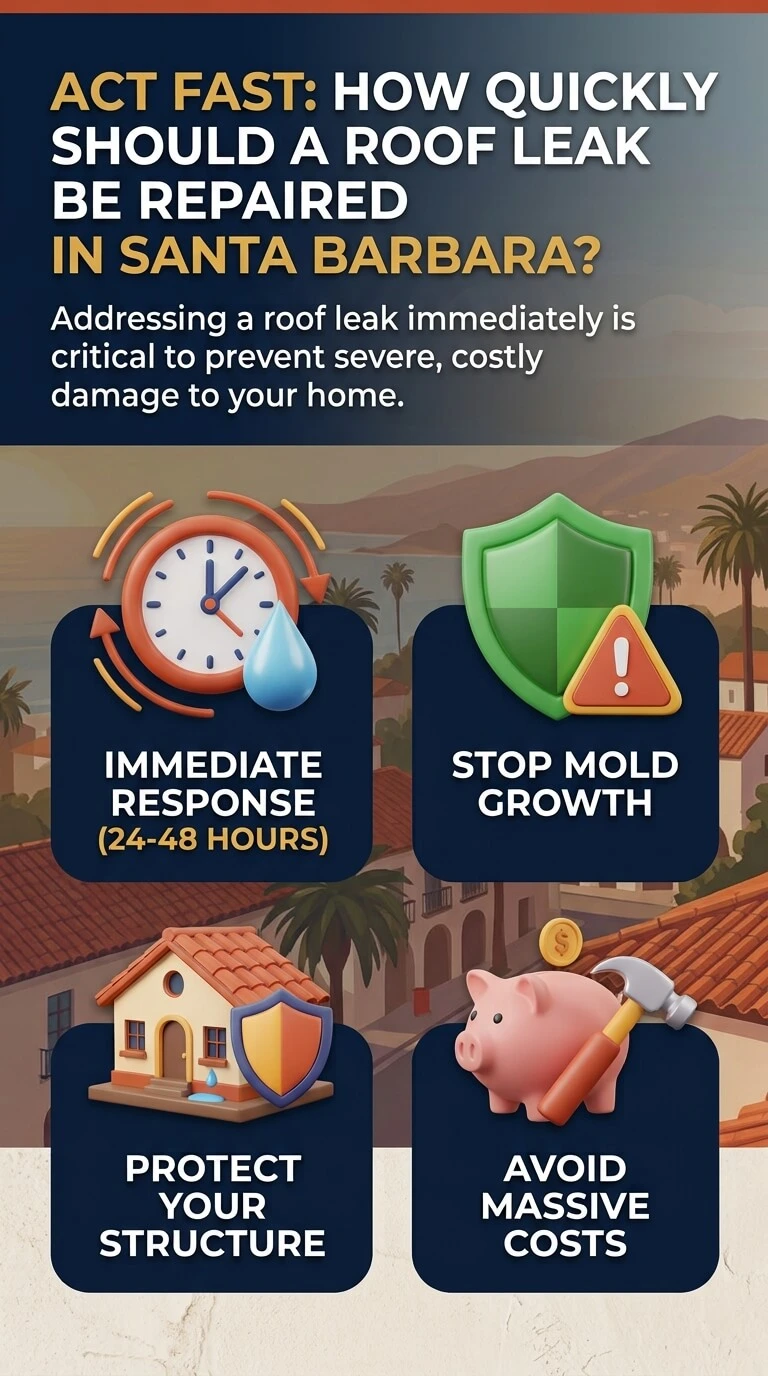
Act fast on leaks: Stop the water the same day, get temporary protection within 24 to 48 hours, and finish the repair within days.
Look under the tile: On clay and concrete tile roofs, the underlayment and flashing usually fail first, even when the tiles look perfect.
Schedule before the rain: A dry roof in fall is easier and cheaper to repair than a soaked one in February.
Hire licensed and local: Check any roofer's license with the CSLB. Quality Roofing has held CSLB license #504492 and served Santa Barbara since 1996.
Expect a clear, itemized estimate: Quality Roofing starts every project with a free on-site estimate and a written scope, backs qualifying installs with up to a 7-year workmanship warranty, and is rated 4.8 out of 5 on Google.
Top Takeaways
Stop the water the same day, get temporary protection on within 24 to 48 hours, and finish the permanent repair within days.
A roof works in layers, so the stain you see is rarely where the water got in. Underlayment and flashing can fail under tiles that look fine.
Santa Barbara's short, heavy rainy season leaves little drying time between storms, so waiting costs more here.
Attic water can reach insulation and ductwork and turn a roofing problem into an indoor air problem.
Photograph the damage, hire a licensed roofer, and move quickly to stay in the best position with your insurer.
How Fast Should You Fix a Roof Leak?
Sooner than most homeowners plan to. Not every leak calls for a middle-of-the-night emergency, but none of them should sit until spring. Match your response to what you see:
Water dripping near light fixtures, outlets, or a sagging ceiling: Act within hours. Water and electricity don't mix, and a ceiling holding water can give way.
An active leak during rain: Get a tarp or temporary patch on within 24 to 48 hours. The EPA advises drying water-damaged areas inside that window to keep mold from starting.
A stain or drip that stopped once the storm passed: Book an inspection within a week. Whatever water got in is still sitting in the insulation and the roof deck.
An older roof with no leak yet: Have a roofer look at it before the rainy season. A dry roof is easier, and usually cheaper, to repair.
Just because a roof leak stops when the rain ends does not mean the problem has been resolved. It often returns with the next storm, usually a little worse. If you've recently had an HVAC system installation, it's also worth checking the nearby roof penetrations and flashing to make sure water isn't finding a way in there.
Why Roof Leaks Move Faster in Santa Barbara
Our mild weather makes it easy to put a roof problem off. Local conditions don't go along with that plan.
A short, heavy rainy season
Most of the year's rain lands in a few winter months, and the storms tend to travel in groups. A roof can go from bone dry to soaked in one week with no chance to dry out in between. The small gap that let in a cup of water during the first storm lets in far more by the third.
Clay tile and aging underlayment
Red clay and concrete tile give Santa Barbara its look. The tiles can last for generations. The underlayment under them wears out much sooner, and once it fails, water slips past tiles that look perfect from the sidewalk. Cracked or slipped tiles, tired flashing around chimneys and skylights, and valleys packed with debris let water in too.
Sun and salt air
A year of steady UV dries out sealants and roofing membranes. Marine air goes to work on fasteners and metal flashing at the same time. Then wind-driven rain shows up and pushes water sideways into exactly the spots the sun and salt weakened.
Older homes and hillside lots
Plenty of homes on the Riviera, in Mission Canyon, and up in Montecito have older roof decks, complicated rooflines, and hillside runoff to manage. Every valley, transition, and vent pipe gives a leak another place to start.
What a Small Leak Does When You Wait
By the time you see the ceiling stain, the water has already worked through several layers of the house.
Attic insulation: Wet insulation flattens and stops insulating. Your heating and cooling system runs longer, and the energy bill creeps up.
Ductwork and HVAC equipment: In a lot of Southern California homes, the ducts and air handler sit in the attic. When roof water reaches them, mold can grow inside the system. The EPA warns against running an HVAC system you suspect has mold, because it can carry spores into every room.
Mold and indoor air: The EPA names roof materials above ceilings as a common hiding spot for mold from roof leaks. A musty smell upstairs, or a room that always feels stuffy, deserves a closer look.
Roof decking and framing: Damp plywood and rafters soften and rot, and a patch job turns into replacing part of the deck.
Your insurance claim: Insurers generally pay for sudden, accidental damage and treat slow leaks as maintenance. The California Department of Insurance also warns that your insurer may not pay for ensuing damage if you didn't take reasonable steps to protect the home. Move quickly and keep records. Your own policy has the final word.
What to Do in the First 24 Hours
You don't need to be a roofer to keep the damage small. You need to move fast and stay off the roof.
Catch the water and move your things. Buckets, towels, and a plastic sheet over furniture buy you time. Pull electronics and rugs out of the drip zone.
Cut power to wet areas. If water is anywhere near a light fixture or outlet, switch that circuit off at the panel.
Take the pressure off a bulging ceiling. If drywall sags with trapped water, poke a small hole at the lowest point over a bucket. A controlled drain beats a collapse.
Photograph everything. Get the ceiling, the attic, and any damaged belongings on camera before you clean up. Your adjuster will want to see it.
Call a licensed roofer for temporary protection. A crew can tarp or patch the roof safely. Wet tile is slick, and clay cracks underfoot.
Start drying right away. Run fans and a dehumidifier, and pull back soaked attic insulation. Aim to have materials dry within 48 hours.
Signs of a Roof Leak You Might Miss
Plenty of leaks never drip where you can see them. After the first few storms, watch for:
Yellow or brown rings on a ceiling
Paint peeling or bubbling near the top of a wall
A musty smell in the attic or upstairs bedrooms
Damp, matted, or stained insulation
Cracked, slipped, or missing tiles
Water marks around skylights, chimneys, and vent pipes

“Most of our leak calls in Santa Barbara start the same way. Somebody sees a stain, looks up at the roof from the yard, and decides it can't be much because the tiles look fine. Then we lift a few tiles and find underlayment that's dried out and cracked, or flashing that lets water in for two or three storms. Water can run a long way along the deck before it ever reaches a ceiling. So I tell people not to judge a leak by the size of the stain. Have someone look at it within a day or two, get it covered, and fix it properly before the next storm. That call almost always costs less than the one you'd make in February.”
7 Essential Resources
Bookmark these before the rain starts. They'll help you dry out, check for mold, work with your insurer, and vet whoever you hire.
Expert HVAC Air Duct Mold Remediation Techniques: Start here if roof water has reached the ducts in your attic.
EPA: A Brief Guide to Mold, Moisture and Your Home: Plain guidance on drying wet materials, cleaning small mold patches, and finding mold you can't see.
EPA: Should You Have the Air Ducts in Your Home Cleaned?: When duct cleaning makes sense, and why wet or moldy duct insulation has to come out.
California Department of Insurance: Residential Property Claims Guide: What to do after a loss, how to work with an adjuster, and what a homeowners policy may cover.
CSLB: Check a Contractor License: Confirm a roofer's license is active and look up complaints before you sign anything.
County of Santa Barbara: El Niño 2026-27: The County's storm prep page for this winter, with sandbag locations and emergency storm response.
County of Santa Barbara Flood Control District: Local rainfall records, flood warnings, and preparedness information from Public Works.
Supporting Statistics
24 to 48 hours: The EPA says to dry water-damaged areas and items within this window to prevent mold. The agency also names roof materials above ceilings as a common place for mold to grow after a roof leak. (U.S. EPA)
About half a year's rain by mid-November: Santa Barbara averages 18.44 inches per water year. By November 17, 2025, the city had already recorded 9.5 inches for the season, 8 of them that month. The County called it the wettest start since its record-keeping began in 1899-1900. (Noozhawk, citing the County of Santa Barbara)
$15,400 per claim: Homeowners filing for water damage and freezing collected $15,400 per claim on average from 2019 to 2023. That category made up 22.6 percent of homeowners insurance losses in 2023, and roughly one in 60 insured homes files such a claim each year. (Insurance Information Institute)
Santa Barbara’s heavy seasonal rainfall and the high cost of water-damage claims make early roof maintenance especially important, and if you’re planning a top HVAC system installation, coordinating the work with a roof inspection can help catch flashing, moisture, or penetration issues before they lead to leaks and mold.
Final Thoughts and Opinion
The most expensive roof leak I know of is the one that gets a bucket instead of a phone call. I understand the instinct. The drip stops, the sun comes back, and the week fills up. In Santa Barbara, though, the dry stretch between storms doesn't give a roof time to heal. It gives hidden water time to settle into insulation, ducts, and decking.
This winter could be a wet one. The County of Santa Barbara is already preparing residents for a developing El Niño, which raises the odds of above-average rain. If your roof has an old stain, a slipped tile, or a leak that "fixed itself" last year, I'd get it checked now while the roof is dry enough to work on. A roofer can handle that leak as a repair in October, while the same leak in February often turns into a restoration job.
Frequently Asked Questions
How long can a roof leak go before it causes serious damage?
Not long. The EPA advises drying wet materials within 24 to 48 hours to prevent mold, and insulation, drywall, and roof decking start breaking down soon after. Let a leak ride through two or three storms and a small repair can grow into new insulation, new drywall, and a section of new roof deck.
Is a roof leak considered an emergency in Santa Barbara?
Yes, if water is near electrical fixtures, the ceiling is sagging, or rain is still falling and water keeps coming in. Call for temporary protection right away in those cases. A leak that stopped when the storm ended can wait a few days, but get it inspected within about a week, before the next system arrives.
Will homeowners insurance cover a roof leak repair?
That depends on your policy and what caused the leak. Insurers usually pay for sudden, accidental damage and treat slow, wear-related leaks as maintenance. The California Department of Insurance notes that your insurer may not pay for ensuing damage if you didn't take reasonable steps to protect the property. Document the damage, save your receipts, and call your insurer early.
Can I patch a roof leak myself until a roofer arrives?
Inside the house, absolutely. Catch the water, move your belongings, and start drying. Leave the roof itself to a professional. Wet tile and shingles are slippery, clay tiles crack under a boot, and a licensed roofer can tarp the area safely while tracking down the real entry point.
Why do clay tile roofs leak if the tiles look fine?
The tiles shed most of the rain, but the underlayment beneath them is what keeps water out. That layer wears out long before the tiles do, especially under year-round sun. Cracked or slipped tiles and worn flashing at chimneys, skylights, and valleys let water reach it even faster. That's why a good inspection means lifting a few tiles to look underneath.
Get Your Roof Leak Checked Before the Next Storm
A stain, a drip, or one slipped tile is reason enough to call. Don't wait for the next rain to show you how far the water has traveled. A licensed local roofer can find where it's really getting in, cover the roof right away, and walk you through a clear, itemized plan for a lasting fix. If rooftop equipment like Heat pumps is nearby, the roofer can also check the surrounding flashing and penetrations for possible leak points. Quality Roofing has worked on Santa Barbara roofs since 1996, and every project starts with a free on-site estimate and a written scope. Their crews know the clay tile, coastal, and hillside roofs common around here, and they treat every roof as if it were their own. Call this week, while the skies are still clear.