That kind of whiplash is normal for air quality in Wisconsin, even if the July numbers weren't. Wisconsin sits between two Great Lakes, downwind of the forests of Minnesota and Ontario, with summers that turn humid and winters that go cold and still. Wildfire smoke, lakeshore ozone, and winter inversions take turns setting the number on your screen, and any one of them can move it within hours.
TL;DR Quick Answers
Air Quality Wisconsin
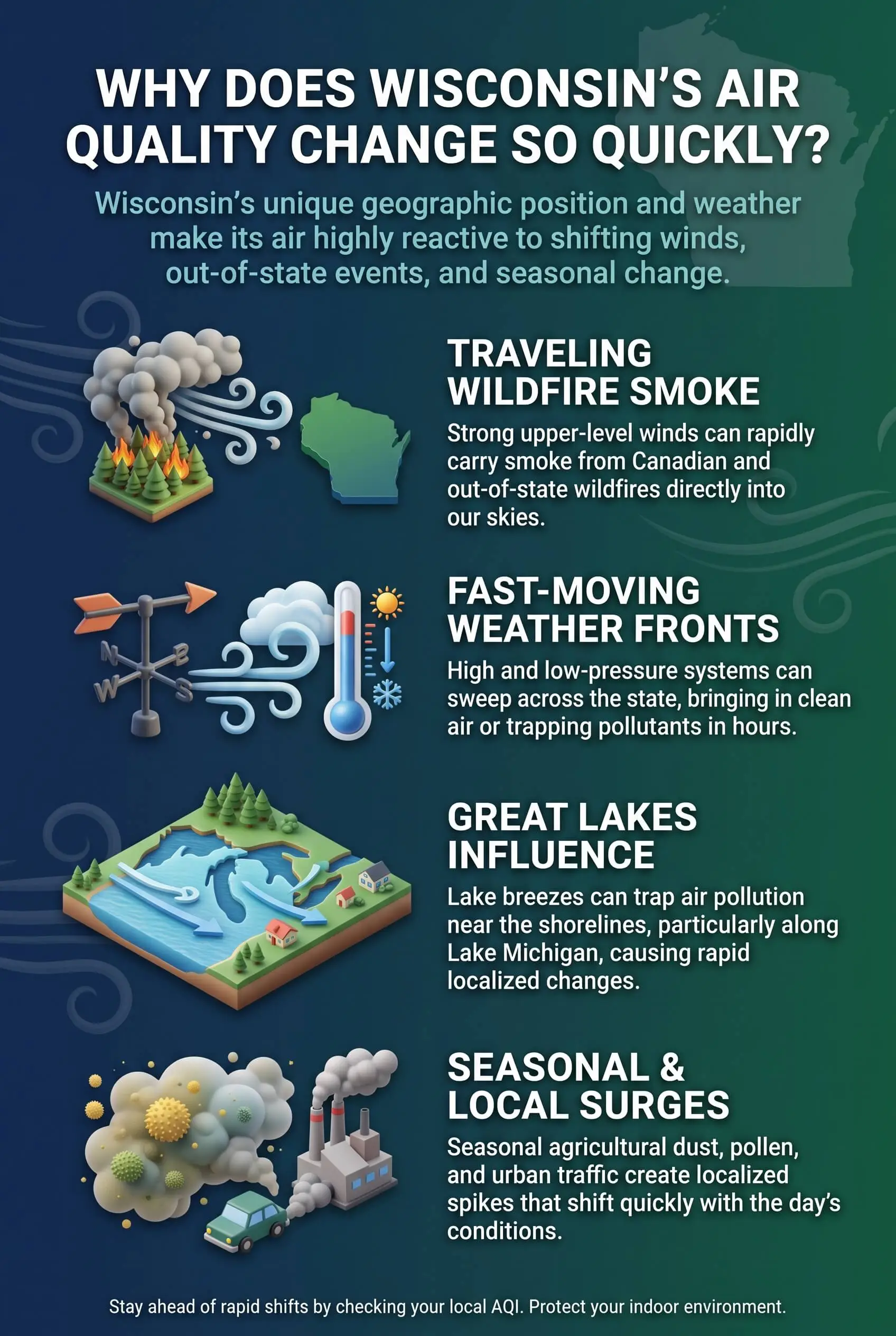
Air quality in Wisconsin changes fast because the weather keeps carrying pollution in. Wildfire smoke from Canada and Minnesota drives the highest readings. Lake Michigan breezes push ozone onto the shoreline on hot afternoons, and winter inversions trap emissions overnight. Since 2020, smoke alone has caused about nine unhealthy air days a year.
Wildfire Smoke: Reaches Lake Superior counties first and hits hardest there. Trust the ground-level AQI reading over a hazy sky.
Lakeshore Ozone: Peaks from mid-afternoon into early evening in Kenosha, Milwaukee, and Sheboygan, while inland areas often stay lower.
Winter Inversions: Readings climb overnight, peak near sunrise, and usually drop by early afternoon.
When to Act: Sensitive groups should cut back outdoors once the AQI passes 100. Above 150, everyone should.
Inside Your Home: Outdoor particles slip in through gaps and fresh-air intakes. Close the windows, set the thermostat fan to “On,” and run a MERV 11 filter or the highest rating your system can handle.
Top Takeaways
Wind decides the day. Most big swings come from pollution carried in, not made nearby.
Smoke has become routine. Unhealthy smoke days jumped from under one a year to about nine since 2020.
The lakeshore has its own ozone problem. Lake breezes push high ozone onto a narrow strip of shoreline.
Winter brings morning spikes. Inversions trap emissions overnight and usually lift by early afternoon.
Indoor air follows outdoor air. Close up, run the fan, and use a MERV 13 filter once the AQI passes 100.
What Makes Air Quality in Wisconsin Change So Fast?
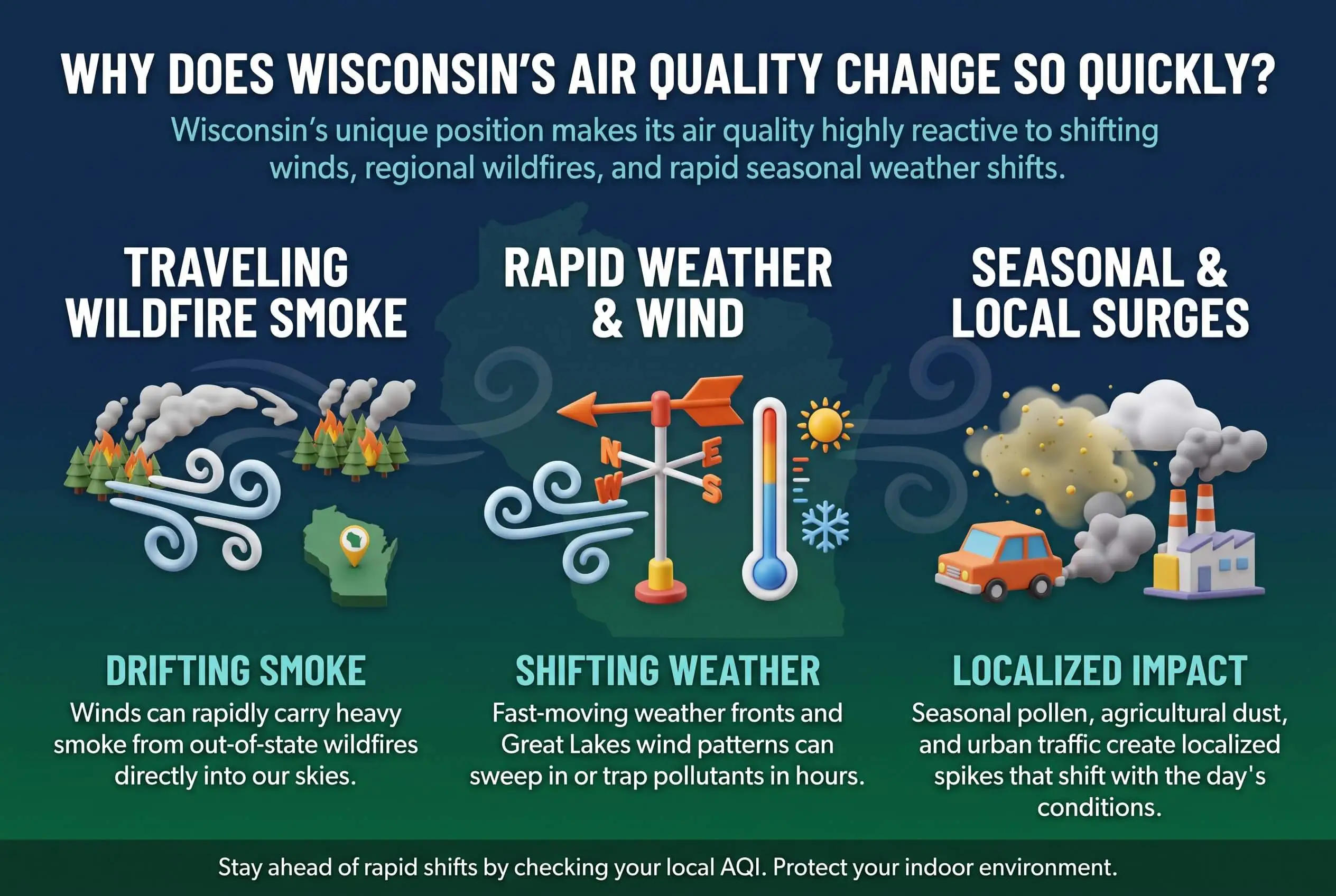
Most of what pushes Wisconsin's numbers around arrives on the wind, gets trapped by a cold night, or forms when summer sun cooks exhaust. Little of it comes from a steady source. Shift the wind and you shift the source.
Here's something that might surprise you: part of the speed comes from the math. Live maps calculate fine particle and ozone readings with the NowCast, which weights the most recent hours heavily so the number reacts to the air right now. Official advisories often lean on 24-hour averages instead. So the app on your phone can jump a full color category between breakfast and lunch while the daily figure moves more slowly. When fine particle levels rise, top air filters can help capture airborne particles indoors while outdoor conditions change.
Most of the big swings trace back to one of these:
Wildfire smoke that travels hundreds of miles from Canada and Minnesota.
Ground-level ozone that Lake Michigan breezes push onshore on hot afternoons.
Temperature inversions that pin local emissions close to the ground on cold, calm nights.
How Wildfire Smoke Travels Into Wisconsin
Smoke drives the state's most dramatic readings, and summer smoke days have stopped being rare. A Clean Wisconsin analysis counted fewer than one unhealthy smoke day per year from 2010 to 2020. Since 2020, the state has averaged about nine.
The July 2026 event showed how fast it moves. Hot, dry, windy weather let fires in northern Minnesota and Ontario grow quickly. The Wisconsin DNR issued a statewide advisory on July 14, smoke reached the northern counties that night, and by the next day it was sliding south toward La Crosse and Janesville. DNR staff called it some of the worst wildfire smoke the agency has measured on record.
Why Hazy Skies Don't Always Mean a High AQI
Smoke can ride thousands of feet overhead and never touch the air you breathe. NOAA's satellite smoke maps show where plumes sit, but analysts build them from daytime imagery, so clouds and darkness can hide smoke from view. A gray sky with a green or yellow reading usually means the smoke hasn't come down yet. Afternoon warmth can mix it down, so check the ground-level number again later.
Why Northern Wisconsin Usually Gets Hit First
Fires in Canada and Minnesota usually send smoke in from the north and northwest, so Lake Superior counties tend to see it first and thickest. In July 2026, the DNR also warned it could pile up near Lake Michigan. A cold front and a wind shift usually bring relief.
Why Lake Michigan Creates Shoreline Ozone Spikes
If you live near the lakeshore, your worst air days may have nothing to do with fire. Sunlight turns vehicle and industrial emissions into ground-level ozone, and on hot summer days a lot of that ozone forms right over Lake Michigan. Then the afternoon lake breeze carries it onshore.
A Wisconsin DNR technical analysis found high ozone packed into a narrow strip along the shoreline. At the Kohler Andrae monitor on the Sheboygan County lakeshore, the 2014 to 2016 ozone design value hit 79 parts per billion. An inland monitor 3.2 miles away came in at 69. The DNR traced most high-ozone hours to air blowing in from over the lake, carrying emissions from the Chicago area and beyond.
So Kenosha, Racine, Milwaukee, and Sheboygan can log an orange ozone afternoon while Madison stays yellow. Expect the peak from mid-afternoon into early evening, with levels usually easing after sunset.
How Winter Inversions Trap Pollution Near the Ground
Air usually cools as it rises, which gives pollution room to drift up and thin out. Clear, calm winter nights flip that. The ground loses heat fast, a layer of warmer air settles on top like a lid, and wood smoke and exhaust stay stuck underneath.
Once you know the pattern, it's easy to spot. Readings climb overnight and peak around sunrise. By early afternoon, sunshine warms the ground and stirs the layers, and the numbers drop. River valleys in the Driftless Area and low-lying neighborhoods feel it most.
When Wisconsin Air Quality Swings the Most
Spring: Tree pollen and planting dust add particle stress across farm country.
Summer: Ozone peaks along the lakeshore, and wildfire smoke can show up any week from May through October.
Fall: Harvest dust and backyard leaf burning cause short, local spikes.
Winter: Inversions hold wood smoke and exhaust close to the ground on cold, windless mornings.
What Fast AQI Swings Mean for the Air Inside Your Home
Don't take your indoor air for granted when the outdoor number climbs! Your home isn't sealed. Fine particles slip in around doors, window frames, and fresh-air intakes, and a smoky afternoon outside turns into a hazy evening inside if nothing catches them. An air purifier with a HEPA filter can help capture fine particles that make their way indoors. Wisconsin health officials advise sensitive groups to cut back on strenuous activity once the AQI passes 100, and everyone to scale back above 150.
Here's exactly what to do inside:
Close windows and doors once the AQI passes 100, and switch any fresh-air intake to recirculate.
Move the thermostat fan from "Auto" to "On" so air keeps passing through the filter.
Run a MERV 13 filter, or the highest rating your system's fan and filter slot can handle.
Check the filter after any multi-day advisory, and swap it once it looks gray or airflow drops.
Hold off on candles, frying, and vacuuming during smoke events, because each one adds particles indoors.
Pro Tip: Swings run both ways. When a cold front clears the smoke and the AQI drops back into the green, open the windows for an hour to flush stale air. Then sign up for DNR air quality alerts so the next swing doesn't catch you off guard.
"After years of watching Wisconsin smoke seasons, I've learned the filter tells the truth before the forecast does. A three-day smoke advisory can load a MERV 13 filter like weeks of normal use, and on the lakeshore in Sheboygan or Kenosha, ozone often peaks in late afternoon when the breeze turns onshore”
7 Essential Resources
Live Wisconsin Air Quality Map: Real-time AQI readings across the state, city rankings, and filtration tips for high-AQI days.
Wisconsin DNR Air Quality Program: The state's monitoring network, smoke guidance, and sign-ups for advisory updates.
Wisconsin DHS Wildfire Toolkit: Who faces the most risk from smoke, and what to do at each AQI level.
EPA: Wildfires and Indoor Air Quality: Filter ratings, fan settings, and clean-room tips for smoke events.
CDC: Keep Wildfire Smoke Outside: Quick steps for keeping smoke out of your living space.
NOAA Hazard Mapping System Fire and Smoke Product: Where satellite smoke plume maps come from, how often they update, and what they miss.
American Lung Association: State of the Air, Wisconsin: County-by-county grades for ozone and particle pollution.
3 Supporting Statistics
Clean Wisconsin found that wildfire smoke caused unhealthy air in Wisconsin on fewer than one day per year from 2010 to 2020, then about nine days per year since 2020. The group also ties smoke exposure to an estimated 250 premature deaths in the state each year. Clean Wisconsin Analysis of Wildfire Smoke Health Harms
Preliminary AQI readings topped 800 near Superior on July 16, 2026, and passed 650 in parts of eastern Wisconsin, including Milwaukee and Kenosha. Wisconsin Watch: Hazardous Wildfire Smoke Coverage
Wildfire smoke triggered air quality alerts on 22 days in Wisconsin in 2025, one day short of the 2010 record. Wisconsin Public Radio: Hazardous Pollution as Fires Burn
Final Thoughts and Opinion
Here's my honest opinion: Wisconsin's air moves fast, but it hardly ever moves at random. Smoke rides in on north winds, ozone follows the heat off Lake Michigan, and inversions settle in on still winter nights, and each one leaves clues in the forecast and in the sky. The trend worries me more. Smoke days have gone from rare to routine, so I'd plan for them every summer rather than scramble at every advisory. Check the live number before you open the windows, and keep a fine-particle filter in place from May through October. Do that, and you're the hero of your household's air no matter how quickly the outdoor reading moves.
Frequently Asked Questions
Why Is Wisconsin Air Quality Bad Today?
Usually one of three things: wildfire smoke drifting in from Canada or Minnesota, summer ozone along the Lake Michigan shore, or a winter inversion holding local emissions near the ground. A live map lists the main pollutant, and that tells you which one is driving today's number.
Does Lake Michigan Affect Air Quality in Milwaukee?
Yes. On hot days, ozone that forms over the lake rides the afternoon breeze onshore. That's why lakeshore cities like Milwaukee, Racine, and Kenosha can read higher than neighborhoods a few miles inland.
How Long Does Wildfire Smoke Usually Last in Wisconsin?
Many smoke events clear within a few days, usually once a cold front or wind shift arrives. They drag on longer when fires keep burning upwind and the weather pattern stalls.
Is Air Quality Worse in Northern or Southern Wisconsin?
That depends on the pollutant. Northern counties along Lake Superior often get wildfire smoke first and worst, while the southeastern lakeshore sees more ozone days in summer. Indoors, pollutants like dust and pet dander can affect air quality regardless of the season.
Should I Run My HVAC Fan When Air Quality Drops?
Yes, as long as your system has a good filter. The EPA suggests switching the fan to "On" during smoke events, which sends air through a MERV 13 or higher-rated filter more often.
Stay a Step Ahead of Wisconsin's Fast-Changing Air
Check the live reading before you open the windows or head outside, because Wisconsin's air can change in a single afternoon. Keep a fine-particle filter in place and the fan ready, and make sure your heat exchanger is properly maintained to support efficient airflow and ventilation, so the air inside your home stays steady even when the sky outside won't.